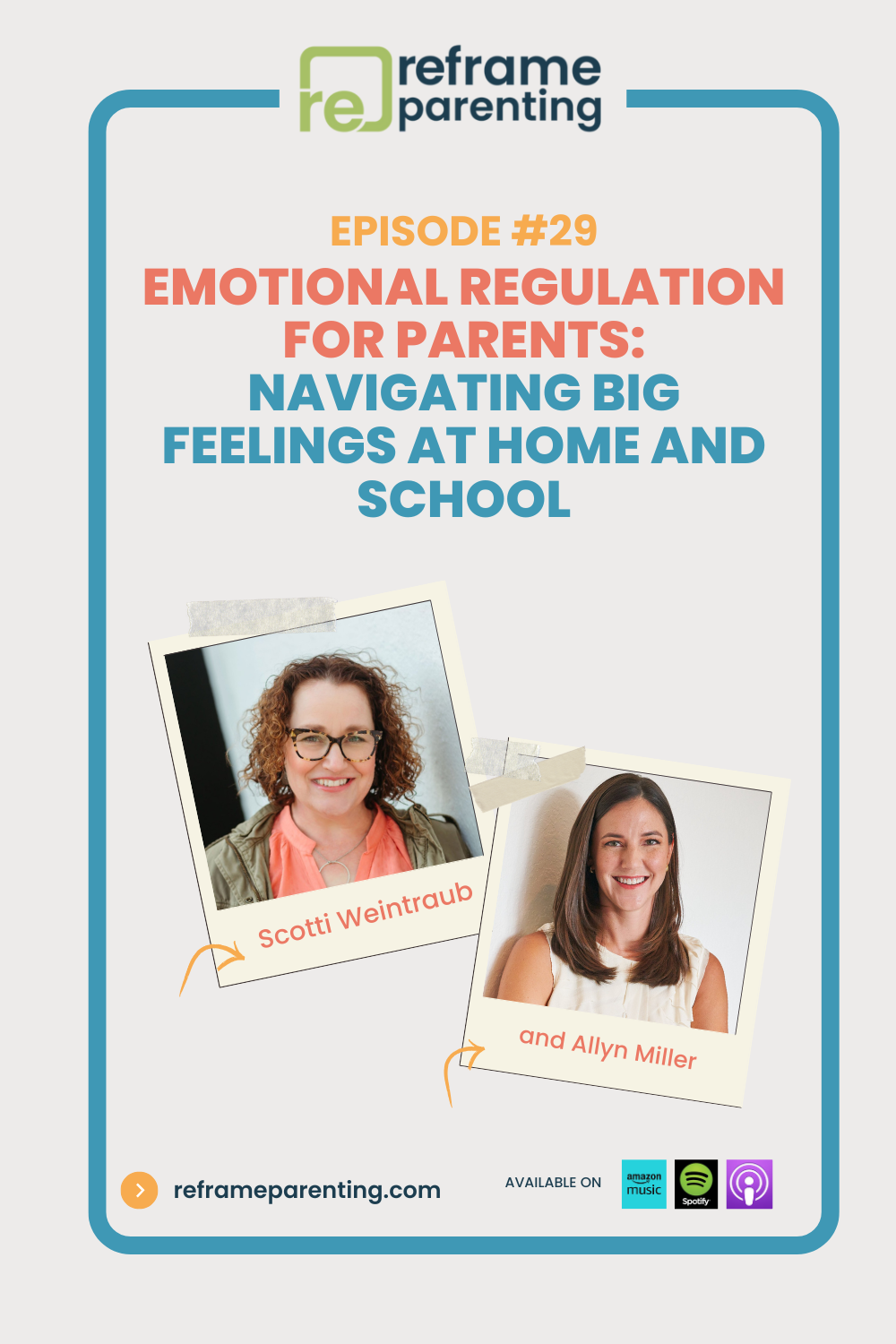
29: Emotional Regulation for Parents: Navigating Big Feelings at Home and School
Your kid melts down, the school emails (again), and suddenly you can feel your whole body go into “mama bear” mode.
In this episode, I’m joined by parent coach Allyn Miller (founder of Child Connection) for a down-to-earth conversation about what regulation actually means—and why it’s not the same thing as being calm all the time. We talk about how our nervous systems respond under stress (fight, flight, freeze, and even fawn), why neurodiverse kids can have bigger reactions, and how parents can start with one powerful first step: noticing what’s happening in your body before you react.
We also dig into power dynamics in parent-teacher relationships, the role of humility and collaboration, and how “redos” and repair can be the most practical (and effective) tool in your parenting toolbox.
Key Takeaways:
Why regulation isn’t “stay calm,” but having a nervous system that can flex to match the situation
A simple self-check practice: noticing body signals (tight chest, clenched jaw, racing heart) before words come out
How fight/flight responses often show up verbally in parenting (“Just get over it” vs. “Whatever, I’m done”)
What “flow/find another way” looks like—and why it’s the sweet spot for problem-solving with schools
How perception can feel like reality for kids (especially neurodiverse kids), even when adults see it differently
The hidden role of power dynamics between parents and teachers—and how to reflect on your own relationship to power
Why “assume good intention” can change everything (with your child and with educators)
How to use repairs and “redos” after a hard moment—without pretending it didn’t happen
Resources:
Connect with Allyn Miller + grab her “number one tool for moms (and dads) to keep cool”: https://child-connection.com/
Connect with Scotti:
Website
Instagram
Threads
LinkedIn
Connect with Allyn:
Ask a Question:
Got a school question on your mind?
Submit it as a listener question for a future episode
Transcript
29: Regulation Isn’t Staying Calm: How to Parent and Advocate in Flow with Allyn Miller
Allyn Miller : [00:00:00] the first thing to really help parents when their child is needing them to be their advocate, is to remember I am here to support my child, and the teacher or the staff, the administrators, the school representatives, their job is also to support my child. We have that in common.
But if a parent can recognize, "Ah, you know what? I do feel really nervous about this. I don't know what to say. I'm afraid to say anything here because the teachers, they have the power," you can ask yourself, "Is that true here, or is that what I'm telling myself because of my past experience?"
Scotti Weintraub: Welcome to Unlocking School Success, a podcast with the smart strategies and support parents need to help their kids thrive. I'm your host, Scotti Weintraub, parent coach, school navigator, and your go-to guide for turning School Stress and Chaos into clear strategies [00:01:00] that work. Let's get started.
Hi, welcome back to another episode of Unlocking School Success. As always, I love having guests, and today's is no exception. Today, I have Allyn Miller. She's a parent coach and founder of Child Connection. And she and I were talking before we started about how much we love doing this work, so I am thrilled to talk today about regulation.
Welcome, Allyn.
Allyn Miller : I'm so glad to be here. Thanks, Scotty.
Scotti Weintraub: I find this word, regulation, a little challenging, 'cause I don't think it's super descriptive.
Allyn Miller : Nope.
Scotti Weintraub: And can easily be confusing. So why don't we start with the broad level overview. When we talk about regulation, what are we talking about?
Allyn Miller : That is a great question. I'm really glad you asked, because I think a lot of people assume that if they are regulated that means [00:02:00] they are calm, and that is a very common misunderstanding. And what I have learned is that healthy regulation, like a, having a nervous system that is regulated, means that it will fluctuate so that it can respond to your external and internal environment.
So a basic example I like to give is if you see your child chasing a ball into the street, into traffic, please don't stay calm. Please get up and go and run and grab their hoodie and pull them back to safety. If there is a suddenly intense threatening situation, yes, get up and go. Act swiftly.
Don't think about it. And then when everyone is safe, then come back to thinking through things, choosing your words, caring for others. So regulation is not about being static. It's about being responsive in a way that matches the [00:03:00] situation.
Scotti Weintraub: I like that idea about matching the situation, 'cause I think that's a really important distinction, and thing for me to keep in mind too, that it isn't about being just calm and laid back all the time, because that isn't actually an appropriate response all the time.
Allyn Miller : No. If something is harming somebody else or if there is a true threat or a true danger, you want to have a more elevated, more activated response. If, and if it's more intense than that and some sort of active response isn't going to be enough, then yes, you get to go in protective, like possum play dead mode.
And I would say in our human experience, that's much less likely. And in human interactions this, the slippery slope is what's a real danger? If I'm talking to another person, is there a real danger or a real threat? And most often the situation is no, there's not real danger or threat, but our [00:04:00] systems perceive danger and threat.
And so I think that is where parents talking with teachers and adults talking on behalf of supporting children, that's where it gets tricky, that there's a lot of perception happening, and then there are reactions coming from those perceptions.
Scotti Weintraub: Yes, and it's tricky because the perception doesn't always match the reality.
And sometimes, when we're talking about our kids who maybe, if folks are listening to this podcast, likely neurodiverse or have other challenges, so for those kids it's particularly hard. Why is that?
Allyn Miller : Yeah. For adults, our perception is formed through our experience, and as adults, those perceptions have been forming for a very long time.
For children, especially children or even adults, anyone that experiences some [00:05:00] neurodiversity the wiring, the mechanisms the neural connections can be formed in a way that make those perceptions more challenging, where somebody might get triggered more easily or somebody might under-respond to something that is a big deal.
It's very subjective, and what I try to offer to parents is that especially when noticing their children and their children's responses, whatever is happening in the child's world is real for them. It's not an adult's job to question a child's perception, but to question where that perception is coming from.
What they are experiencing is real for them. Now let's get curious about how we can support them to see a little bit more of the picture or to see themselves more clearly and why this is hard or why this is challenging.
Scotti Weintraub: I think as a parent [00:06:00] that piece is really difficult sometimes. Yeah. Because we have, as you said a lifetime of experience and potentially different brain wiring than our kids.
And so we can see a situation and think their response is completely out of alignment with what is happening.
Allyn Miller : Yeah.
Scotti Weintraub: And then that causes frustration-
Allyn Miller : Yes ...
Scotti Weintraub: or anger or, you know- a lot of different feelings. What do we do as parents when we have that kind of mismatch?
Allyn Miller : I used to teach in the classroom for about 10 years, and so for the adult, whether it's the parent or the teacher in the classroom-
Noticing a child's kind of over-response to a situation, and then noticing our own big response to their over-response.
That first step, it's like sitting on the airplane, put your oxygen mask on first. When things are starting to heat up between an adult and a child, [00:07:00] first check with yourself. And a lot of people think that check-in is what am I thinking?
Oh, I'm really mad right now. I would invite even stepping, taking one step further back. Now, don't worry about emotions yet. Notice your body first. Is your heart racing? Have you started clenching your hands? Did your throat tighten up? Do you feel your jaw clenching? Is your brow knitted together?
Notice your body first, and that is gonna be a pretty clear sign of how activated you are. Maybe you're s- you say something to your child, and they fly back at you with a really sarcastic response or they slam something down, and now you're mad at their response. Notice yourself first.
Notice the tightening in your chest, and understand, I'm in my own activation. And from [00:08:00] there, either it's really hard, but notice your own activation and know if I continue forward, this is coming from my own activation, and I might have to clean some things up later. Or I'm really activated. I can step aside and give myself 10 seconds to at least take the edge off and see what else I could do differently.
And just that micro process takes a lot of practice because it's not baked into our typical interactions. We just we feel something, we think something, and we do something, and we just all vrip. It's all automatic. So this kind of checking in on yourself is getting out of that automatic pattern to give the adult more space for choosing what they're gonna do.
Because what they g- what they do is going to impact their child in return.
Scotti Weintraub: Yeah, I think there are a couple different pieces of what you just talked about that are so interesting. One being that, that piece of what we do [00:09:00] in those moments will impact what comes next.
Allyn Miller : Yeah.
Scotti Weintraub: And that sort of piece about- Our own lack of regulation, and whether that's us as a parent, whether that's a teacher in a classroom that lack of, if we're feeling activated, what then, let's talk about that.
What comes if we respond, not in the way you suggested, which was to, take some deep breaths, try to look at ourselves more objectively in the moment, which I agree takes practice. Yes. It is not does not come naturally to all of us. What does happen if we aren't able to harness that?
Allyn Miller : Yeah. So actually, I was jotting down some notes, 'cause there are so many different words that circulate around, like different nervous system responses. And the two most common are the fight or flight response. When you get activated, so your system is saying, "Alert. Watch out. We gotta do something here," and the fight response is to make [00:10:00] yourself bigger, stronger, louder to squash that threat, or the flight response, which is, "Get up and go.
Save yourself. Run." In our interactions with our children, it's usually not our physical body that is showing these responses. I think I'm willing to trust that most parents are not physically attacking their child-
...
Allyn Miller : In a hard moment, or they're not literally running out the front door and running away from the house in a hard moment.
They're there, but then the verbal interactions become an expression of that fight response or flight response. So we might verbally shut down our child with something like, "Just get over it. That's not a big deal. Just suck it up," or something that diminishes their reality. The flight response might sound like "I don't care.
I don't, whatever. I'm out of here. It doesn't matter to me," and basically checking out from the child's reality. And so- We have these big reactions coming from us, and they can [00:11:00] come out physically or they can come out verbally. And so those are the two most common. There's also the freeze response, which is the deer in headlights.
No response Yes ... because I just don't know what to say or do. And there's also the fawn response, which I don't talk about that much because it's very nuanced, but it's like this ability to pretend something is okay when we feel inside that it's not. And I would say I was thinking about this fawn response more in adult-to-adult interactions than with our children.
I think that a lot of parents, go unfiltered around their children. It's they're my kid. They're attached to me. They depend on me. I'm just gonna do what I'm gonna do, and I'm not gonna try too hard." But with adult-to-adult interactions there's that fawn response where we want to show up as if everything's okay.
We want to seem pleasant and polite and socially [00:12:00] accepted even though we're not feeling that on the inside. And I think that fawn response has a lot to do with what we've learned about authority and power. And I'm thinking about both sides of that equation. If I'm the parent and I've gotten an email home about my kid's behavior, and I'm speaking from real-life experience, I
Scotti Weintraub: join you in this experience, yeah
Allyn Miller : I might be inclined to write back and apologize and, "Yes, we're gonna talk about this. We're gonna take care of this. Oh, we won't, this won't happen again," and just go overboard with pleasantries and niceness to m- make sure the teacher will wanna keep talking to me. And on the flip side, I used to, I, when I was a teacher, if parents came to me upset about something, I would do all sorts of and say all sorts of things to just reassure them and hope that they would continue trusting me, and present myself as this caring "It'll be okay, [00:13:00] I promise," kind of stance.
Which isn't to say that things wouldn't be okay, but we can go overboard and skip our real feelings when we go into that- ... fawn response. And so back to this regulation also means you get to feel what you're feeling and let that be real, and as an adult, find ways to express that where there, there's still a healthy dynamic in the relationship.
I'm trying to think of a few quick examples, but it's just like you can be able, you can tell the teacher, "Wow, I feel really disappointed to hear this report about what happened at school." That can be real, and that can still be part of the conversation. I'm a little nervous about what repercussions might be coming in the next few days," you can say that.
You're a real person. So I think that's the other piece of regulation, that we get to fluctuate, and when we notice ourselves, we can express ourselves with a little a little more honesty perhaps, so that we can go toward- [00:14:00] collaboration.
Scotti Weintraub: I am so glad you brought this up because collaboration is what I talk about all the time- Yeah
with teachers, and it is such an important piece to realize that in a response to, as you said, like an email that comes in or, something happens and y- It's okay to have those feelings because I think a lot of feelings come up for us. Yeah. That email drops, especially if you've been getting them regularly.
Yeah. It, it makes your heart sink. Maybe you're feeling a little activated by even seeing the message-
...
Scotti Weintraub: Let alone if you get into a meeting situation where you're feeling vulnerable as a parent. Yeah. Because I think it's also important to acknowledge, like, all of that social pressure that is also part of that piece.
Yes. That "Oh, no, my child is a reflection of me, and their behavior is a reflection of me, and therefore, when I get that bad feedback, what is it saying about me?"
Allyn Miller : [00:15:00] Yes. Yeah,
Scotti Weintraub: so many cases. Which is hard. Yeah.
Allyn Miller : It's
Scotti Weintraub: so hard. And so we come into those interactions with the weight of all of that, and as you said we can have those emotions, and how do we do that in a way that maintains our ability to, process our own feelings and not placate or...
And sometimes, I talk to a lot of parents who really do need to advocate for their kid.
Allyn Miller : Yeah.
Scotti Weintraub: And so how do we manage that piece of we gotta stand up? Without- Yeah ... losing our cool, charging in there, coming in- ... real, real hot.
Or just fawning and saying I guess this is okay."
Allyn Miller : "Well"- Yeah. That's, that is, I th- you know, there are a lot of people, myself included, that will go on and be ready to support you for days, weeks, months, years to step into this so that it becomes more natural. But I think the first thing to really help parents when they, when their [00:16:00] child is needing them to be their advocate, is to remember I am here to support my child, and the teacher or the staff, the administrators, the school representatives, their job is also to support my child.
We have that in common. And I think for a lot of parent and teacher interactions, it can start to feel adversarial, and that reminder we are both here for this child's success can help reestablish that baseline that whatever I say, whatever you say, if it is going in the direction to support this child then we've got something.
And another nervous system response that I didn't talk about yet is the flow or the find another way, where you are, for all intents and purposes calm, clear-headed available to use your prefrontal cortex and [00:17:00] evaluate decisions and be in collaboration. And so anything that helps you get into that find another way space, especially when you're interacting with another adult, is gonna be a big step forward because the adults just going at each other and going in circles is not gonna help the child.
And and it spills over onto the child as well. If the teacher has residual big feelings, those interactions are gonna be felt for the child. If the parent is carrying guilt or shame or frustration, that's gonna spill over as well. So as much as possible for all of the adults to recognize what's theirs and make a commitment, "I'm here to support this child," that, that'll be a noticeable difference.
Scotti Weintraub: I like this idea of flow, Because it's about problem-solving.
Allyn Miller : Yes.
Scotti Weintraub: And figuring out a way to [00:18:00] get to- Where we need to go to support your child, right? And that, I think, is the key to everything that I talk about, is how can we work together to get to whatever that looks like. And it is really hard.
I think the other piece too that we often don't think about are around power dynamics. Yes. And how, when we... It is just the truth that there are power differentials happening between interactions between parents, and just as there are between students and teachers, there are between parents and teachers too.
And that's not to say that it's a bad thing, it just is.
Allyn Miller : It is, yeah. I think for a parent to, to be willing to explore their relationship to power dynamics could be really beneficial. It could go in a lot of different directions. If a parent has had a lot of negative school [00:19:00] experiences, they may feel like they have less power than the teacher from their past experience, and that may or may not have some element of truth in the current situation.
But if a parent can recognize, "Ah, you know what? I do feel really nervous about this. I don't know what to say. I'm afraid to say anything here because the teachers, they have the power," you can ask yourself, "Is that true here, or is that what I'm telling myself because of my past experience?"
And on the flip side, maybe there's a parent coming in that, has some amazing professional experience or has other areas that are, like, telling them they are powerful in their lives, and so they come in ready to dominate and prove their power to the teacher. Again, asking that honest reflection am I trying to use more of my power here to be bigger, louder, smarter than the teacher?
Is that what's really needed here? Is that what's real here, [00:20:00] or is this coming from something else? And it's, those are really vulnerable questions because power moves things. And when it comes to helping our children, if we can set that power dynamic at least to the side for a little bit then the synergy of two caring adults working together to support a child actually becomes the most powerful to create positive change and to create environments for success.
Scotti Weintraub: Yeah, this is interesting how all of these things are so interwoven-
Allyn Miller : Yes ...
Scotti Weintraub: because, we've we're talking about regulation, but we're also talking about, communication and power structures. And in the school there are lots of, hierarchies, and we as parents are not even there, right?
We're, like, somewhere- Yeah ... in our own homes or in our own work worlds, and, our kids are operating in this system that we don't always understand. Yeah. So it's such an [00:21:00] interwoven sometimes conundrum. Yes. Sometimes it works beautifully. Yeah. Sometimes it works beautifully, and sometimes it's a tangled, complicated thing.
Allyn Miller : This thought just popped up. There's an interplay between expertise and humility. And when I was a teacher of small children long before I had my own children, and so I found myself in a unique position of wondering, "What the heck could I possibly say to these parents, because I'm not a parent?"
But I think when both sides can really honor their expertise in their area, so the parent is the expert on this child, and the teacher is the expert on this curriculum or this environment, but then step back with humility. As the parent, I don't know everything about running a classroom and being with 20-plus kids all day and trying to meet these standards and [00:22:00] expectations and all of this.
I don't know what that's like. And for the teacher to say, "I don't know this child's whole life experience. I don't know their whole history. I don't know what it's like to be a member in their family." If we can hold on to our expertise where it's real and open up to the humility of all the things we don't know, I think that would create a lot of different conversations.
Scotti Weintraub: Humility is such a great way to talk about this, because it is just that we, as parents, we have- This deep desire to protect and so when we go into those conversations, it's not just about regulation, right? Which is obviously foundational, but it's also about humility
Allyn Miller : Yeah.
There's always something that we don't know- ... which is hard to admit, and it's [00:23:00] scary. It is. It's scary- It is ... to not know.
Scotti Weintraub: And somehow as parents we're just supposed to know everything.
Allyn Miller : Ah, if only.
Scotti Weintraub: If only, right? And admitting that we don't is half, half the challenge maybe.
Allyn Miller : Yeah.
Scotti Weintraub: Let me back up and just say this is partly why I started my business because I felt like as a parent there was so much frustration and feeling like I needed to know how to fix things.
Allyn Miller : Yeah.
Scotti Weintraub: I was expected to know how to fix things, and I did not know.
And I'm a, a researcher and a person who just, like digs in and tries to figure it out, and it was long and painful.
And so I love this idea of like us leading with that humility, and also like our own sense of h- our own responses. And how can we leverage those, yeah. That's such an interesting thing to think about.
Allyn Miller : Yeah, and I think what I wanna offer to parents too is that, let's just give you [00:24:00] a way to do this really imperfectly.
When you get really heated up and you are in full on protect my baby mode, I don't know what is going on over there inside that building, but it's not okay. Notice that and name it as I care so much about my kid.
Scotti Weintraub: Yep.
Allyn Miller : That's why I'm pissed off right now. Like you don't have to back down immediately, and you don't have to sidestep that immediately.
If you can name it and where it's coming from, I love my child and I am demanding that they are cared for in a different way, like l- go with that. Like anger is easy for me to tap into, especially when it's like mama bear protection anger. Sure. Or on the flip side, like the avoidant or submissive, like I, "Okay, if you say so.
Okay, I guess we'll keep trying. Okay, we have to do it that way." Be able to like whisper to yourself, "I'm really scared because I don't know what to do, and these people are saying they know what to do, and I [00:25:00] don't know, I don't know what else is possible here." So you're not diminishing your own experience, but there's a reason for your experience.
Yeah.
Scotti Weintraub: And that's a vulnerable place to be.
Allyn Miller : Yeah. It is.
Scotti Weintraub: Because you have to be willing to be open about not knowing.
Allyn Miller : Yeah.
Scotti Weintraub: And in those moments to be able to say "I understand that I'm feeling very passionate about my child's needs right now." And I don't know how to make the situation better.
That's a vulnerable thing to be able to say. Yeah, this kind of loops back to all the ways that we are not prepared in our lives for these expressions and these, this type of communication, and this self-awareness and self-understanding and empathy. Adults today, I'll just raise my hand as a child of the '80s this wasn't modeled [00:26:00] really clearly.
Allyn Miller : This wasn't taught explicitly, so here we are trying to figure it out. At the same time, we're trying to help our children and help them figure it out sooner than we did. And so I think that's another just remembering for all of the parents and the teachers, this is hard for me. I'm gonna guess it might be just as hard for that person over there.
Yeah, we're all just trying to figure it out.
Scotti Weintraub: I- yes, I think that piece is so critical because I always talk about assume good intention.
Allyn Miller : Yeah.
Scotti Weintraub: Because if we can go into these moments where we feel activated, but we assume that the other person has good intentions, whether that's a teacher or, our kids-
Allyn Miller : Yes
Scotti Weintraub: that's an important one. We, I think there's a lot of feedback we get about that kids want to- make us angry or they want to misbehave, whatever that means. That there's intention behind [00:27:00] it. And I don't think there always is.
Allyn Miller : If, if anything, the intention is, "I wanna be close to you in any way I can."
And kids learn different ways to try and be close, even if the close is, "I'm gonna yell in your face," or the close is "I'm gonna make you... I'm gonna single you out and now everyone's paying attention to you." Most, my most generous assumption is that children are always striving to be seen, and some children learn that they don't get seen unless they do or say these things.
And at the end of the day, a lot of children, back to where you're mentioning children who experience neurodiversity, they're not choosing. They're not sitting there thinking and calculating and planning, "Ooh, what am I gonna do next?" They are responding in a very uninhibited way and that if they could make a choice, what just happened wouldn't have been their first choice.
And so I think just a lot of empathy and generosity for whether a [00:28:00] child's actually making a choice. Usually they're not. And then wherever their reaction or the behavior is coming from, it's often outside of their control.
Scotti Weintraub: Speaking about foundational concepts, I think this just gets to one that I found so revelatory in my own parenting was when I I read Ross Green's work around- behavior as communication. And it really shifted the whole dialogue in my own head about what is the challenges that my kid is having are not about me.
Allyn Miller : Yeah.
Scotti Weintraub: They're not, necessarily what he, that he, 'cause he wants to be bad or, misbehave. It's because something else is going on.
And so- I think that too really helped my own ability to regulate in those moments- ... was understanding that piece that you just mentioned around that [00:29:00] the kids, are they really trying to get at me? That's not-
Allyn Miller : Yeah ...
Scotti Weintraub: actually what's happening. And so if we- Yeah ... let that go- Yeah ... that was freeing.
Allyn Miller : So my children are now 12 and nine, and when I get really annoyed with them or something triggers me, I can usually trace it back to they were having a moment first. It's very rare that they intentionally choose to do or say something to see how I'm gonna respond. And in those rare moments, I usually respond and then they just start laughing at their, at me.
They're like ha, I gotcha. I knew you would do that."
Scotti Weintraub: Yeah, that's... I just, this brings me back to just last night. My teen, I, just to speak to the fact that this stuff doesn't always change over time, was having a very hard time. And it still, it became clear to me the more we talked it through that really his blood sugar was just low.
Yeah. And so it's just the sort of [00:30:00] foundational things of okay, I could have assumed that like his behavior was, if we're being not generous we could say all sorts of mean things about-
Allyn Miller : Yeah ...
Scotti Weintraub: a situation. They were being rude, mean, whatever.
Allyn Miller : Manipulative. Ooh,
Scotti Weintraub: la-la Manipulative ... that's
Allyn Miller : the one that makes my skin crawl.
Scotti Weintraub: Yeah, I don't love that one either. But, if we stayed on that sort of surface level I could have said any of those things. But instead, a- as I always say, put on your detective hat, I was okay, what's, He'd been at a sleepover and probably was not sleeping at that sleepover, and has he eaten enough today?
Oh, probably not. And so just being able to think through my own reaction in that moment of okay, where am I gonna meet that energy-
Allyn Miller : Yeah. Yeah ...
Scotti Weintraub: allowed me to be much more empathetic, allowed me to focus on what could make a difference in that moment, which happens to be getting him to eat something.
Yeah. But that was something I could do instead of just like beating up [00:31:00] against that-
...
Scotti Weintraub: The-
Allyn Miller : Yeah ...
Scotti Weintraub: the meltdown or the, the attitude and the way he was speaking.
Allyn Miller : Yeah. Yeah. I think be- being able to see what our children are bringing to us and consider, where is this really coming from?
It's coming at me, that's where it's landing, but where is it actually coming from? There's usually something else. There is a variable. There's some other influence. There's something else going on, and as parents, that's hard to remember because we're there. We're the target and it's really hard to not go into that self-defense or self-protection, or I'm gonna teach you a lesson.
But to stay in that curiosity. Okay, this is landing on me really hard, and where is this coming from? ... Let me meet you where it's coming from and not just respond to how this is landing on me.
Scotti Weintraub: That isn't to say that we are somehow, 'cause I get this feedback sometimes of "I would never let my kid [00:32:00] speak to me that way," this kind of thing. And that's not to say that we're condoning.
Allyn Miller : No. No and I love that I don't let them speak that way." They just did, so- Do you have a time warp machine where you make them take it back?
I, this is where a redo can be the simplest and super effective experience.
Once you may be able to address some of those underlying factors oh, your blood sugar was low. Okay, now you've eaten. Hey, can we revisit that, and could we- could- you wanna redo that? Let them try it again. And I think all of us, like the adults, we could benefit from redos as well.
Wow, I flew in really hot, and words came out of my mouth that now I regret, and I'm realizing because I was still all up in my head because of a previous conversation, and I did not need to take that out on you. I'd love to do a redo. What I wanted to say, now that I've kinda [00:33:00] calmed down and I can think clearly, what I wanted to say was this, and what I- this is what I really wanted to convey.
Let's just let everybody have some more redos.
Scotti Weintraub: Yes. Because we are running out of time, let's, leave on that positive note of like-
Allyn Miller : Yeah ...
Scotti Weintraub: making repairs, doing that work is so foundational to like... I know we started talking about regulation, and really- Yeah ... what we've gotten into is about bigger issues around communication and relationship.
Allyn Miller : Yes, very much
Scotti Weintraub: and so it just, proves that while this regulation word can feel a little like I'm just supposed to be calm, stay calm or calm down.
Allyn Miller : Yeah.
Scotti Weintraub: Really these are such foundational pieces.
Allyn Miller : Yeah. For me, it's the noticing what sort of response your body's having. Is that a match for what's really going on?
And if you ended up reacting from that big response- [00:34:00] Check on people. If there was harm done, check on them. Offer repair and ask for a redo. And if it's your child that was the one with the big reaction and things have simmered down, let them do a redo. That's where the teaching is. That's where you get to say, "Yeah, we know how to say this a different way.
Yeah, we know how to treat each other with more kindness." Yep, you do know that. And it's those triggered moments that get in the way, so let's do a redo.
Scotti Weintraub: With that I want to offer folks a way to get in touch with you if they wanna work on this regulation piece for themselves.
Tell me how you work with parents and where they can find you.
Allyn Miller : Oh, absolutely. Thank you. I would say my first the first thing I love to invite parents into is my number one tool for moms, and it works for dads, to keep cool. And it is about that self-awareness of how close to calm you truly are and- [00:35:00] What are your own unique signs and signals that you are simmering or boiling or exploding so that you have your own map of knowing where you are.
And from there, a whole lot of different things are possible. So that's my favorite starting point, and then I do work with parents in private coaching and also in my group program, Parenting In Flow, which I offer a couple times throughout the year. So that's what it's all about, parenting in flow.
Scotti Weintraub: Great. So how could someone find the tool you're talking about, which I love this idea, and learn more about your services?
Allyn Miller : Yeah, absolutely. Just head to my website child-connection.com, and you'll see pop-ups and banners and buttons for- ... that number one tool to keep cool.
Scotti Weintraub: Great, and I'll put the links to your website in the show notes so folks don't have to remember that address if you're out-
Listening on the go. I like to finish up these [00:36:00] conversations just asking about a resource, whether that's a book or a website or some place. If people wanna dig in more to this topic, where do you recommend?
Allyn Miller : Oh, I absolutely loved reading the book Beyond Behaviors by Mona Delahooke. And as I was reading it, it was for the purpose of parenting, and I was just all on board, but my past teaching years and heart were also very intrigued, and I just thought, wow, this is a piece that if parents and teachers were both taking this in and understanding this lens, oh my gosh, children children would be so well-cared for, so well-honored and dignified, and really set up for optimal success.
That it really gets to the heart of a child's inner experience and speaks to how the adults in their world can support that healthy connecting relationship [00:37:00] and how the relationship is the biggest influence.
Scotti Weintraub: I love her work. And that book in particular was really impactful for me as a parent too. So- Yeah
thanks for bringing that one to everyone's attention, and I'll of course have a link to it in the show notes. With that, Allyn, it is such a pleasure. I know we could talk a whole other segment about regulation, so maybe we'll have to have you back sometime.
Allyn Miller : I would love that, Scottie. Thank you so much. This is an honor and a pleasure being in conversation with you.
Scotti Weintraub: As always, thanks to everyone listening. This is Unlocking School Success, and we'll catch you next time.
Speaker 3: Thanks for tuning in to Unlocking School Success. If you're finding these episodes helpful, please hit follow, leave a review, or send it to another parent who's also navigating the school maze because no one should have to figure this out alone. You'll find full show notes@reframeparenting.com slash podcast [00:38:00] and you can come say hi on Instagram at Reframe Parenting.
Thanks again for listening. See you next time.