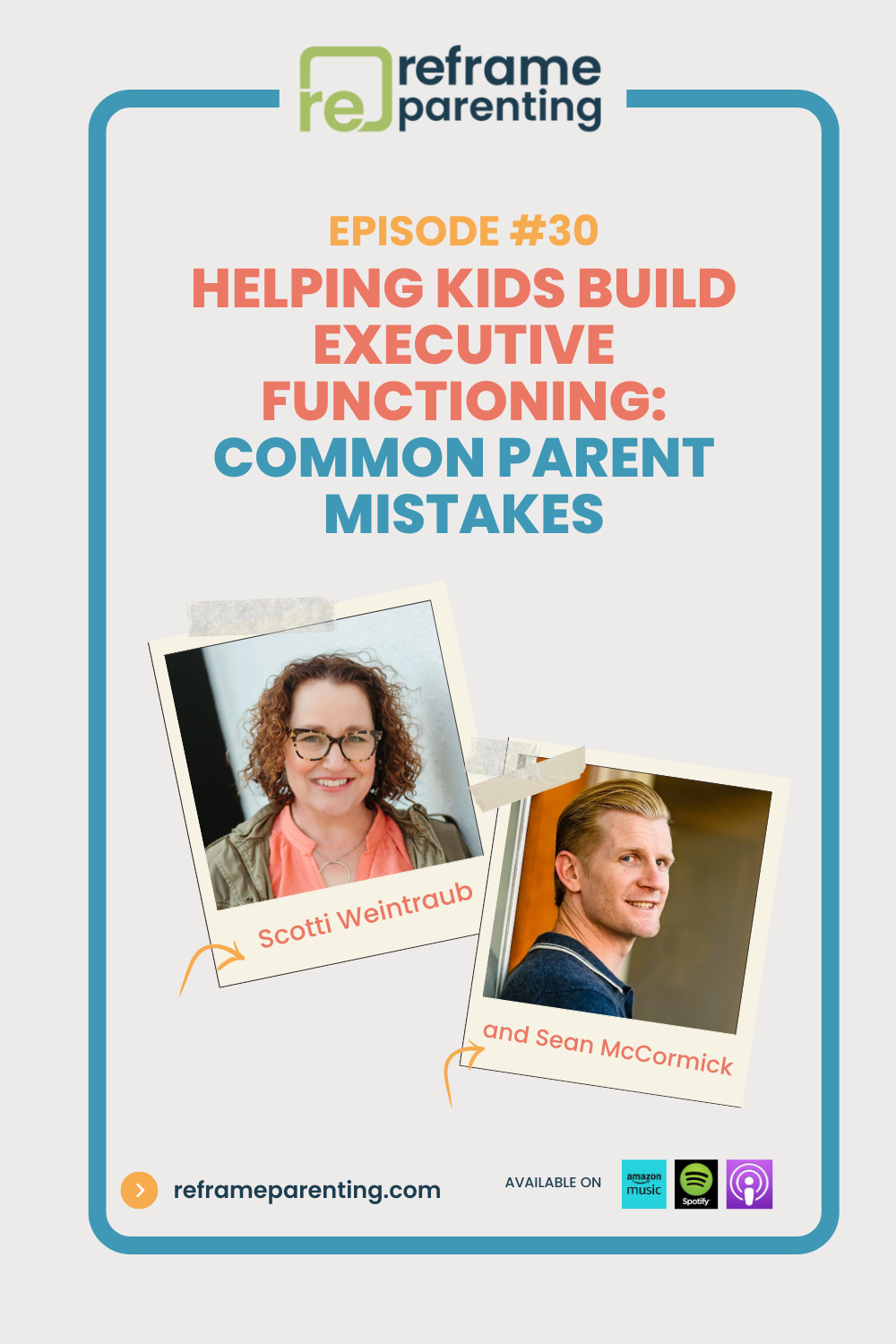
30: Helping Kids Build Executive Functioning: Common Parent Mistakes
If you’ve ever caught yourself thinking, “If they can’t do this now… what happens in middle school/high school/college?!”—take a breath.
In this episode, I’m joined by Sean McCormick (former special ed educator and founder of Executive Function Specialists) for a grounded, hopeful conversation about how parents can support executive functioning without falling into fear, power struggles, or endless nagging.
We talk about why executive function skills matter for life outcomes, how to keep a long-term view when your child is still developing, and small daily shifts that can make a big difference—like narrating your own thinking, focusing on starting (not finishing), and celebrating the tiny wins that actually build confidence.
We also dig into school teamwork, IEP/goal clarity, and why we’re really aiming for interdependence—not “do it all alone.”
Key Takeaways:
Why fear-based “scare tactics” can backfire and increase anxiety (the opposite of executive functioning)
Sean’s POSITIVE acronym for executive function skills: planning, organization, self-awareness, inhibition, time management, initiation, visualizing outcomes, and evaluating priorities
The parenting mindset shift: play the long game (because brain development takes time)
How routines, consistency, and clear boundaries create the conditions for executive skills to grow
A simple reframe that reduces homework battles: focus on starting tasks (even for 3 minutes) instead of finishing
How “declarative language” (cueing vs commanding) helps kids make their own executive decisions
Why small wins need specific praise—and how that changes motivation over time
What “interdependence” really looks like at school, and why teams matter
How measurable, “proof-able” goals help everyone see progress (including your child)
This episode will help if:
You’re worried your child’s struggles now mean they’ll “never” be able to handle what’s next
You feel stuck in a cycle of reminders, nagging, and conflict around school tasks
Your child is overwhelmed by big assignments and has trouble getting started
You want to support executive function at home, even though you’re not in the classroom
You’re navigating a 504/IEP (or just school stress in general) and want clearer goals and better collaboration
You’re trying to build your child’s confidence after lots of negative feedback at school
Resources:
Learn more about Sean’s work + free resources: https://www.efspecialists.com/
NeuroDiversions conference: https://neurodiversion.org/
Connect with Scotti:
Website
Instagram
Threads
LinkedIn
Connect with Sean:
Ask a Question:
Got a school question on your mind?
Submit it as a listener question for a future episode
Transcript
30: Helping Kids Build Executive Functioning: Common Parent Mistakes
Sean McCormick: [00:00:00] if you dump fear into your child, even though it's done with good intention, now they're gonna be cultivating an anxious, non-executive functioning mindset as they relate to the world.
As a parent, you can't do everything. And I kinda like to break the myth of independence. We're not cultivating kids towards independence, we're cultivating them towards interdependence.
Scotti Weintraub: Welcome to Unlocking School Success, a podcast with the smart strategies and support parents need to help their kids thrive. I'm your host, Scotti Weintraub, parent coach, school navigator, and your go-to guide for turning School Stress and Chaos into clear strategies that work. Let's get started.
Hello, and welcome to another episode of Unlocking School Success. As always, I love having guests on my podcast, and I think you'll find that today's guest is a great one. We've got Sean McCormick. Welcome, Sean. It's a pleasure to [00:01:00] have you here.
Sean McCormick: Hey, Scotty. Thank you for having me on. I'm excited to be chatting with you today.
Scotti Weintraub: I know that you are a parent, a former special ed educator, and you've started a couple different businesses that support both kids and families and adults around executive function. So just tell us really briefly about that.
Sean McCormick: Yes. So background, public school special educator. I loved working with kids in the public school system.
But ultimately, when I had children of my own, I just felt like I needed a bit more flexibility. So I took the show on the road and started working with students and families privately. And as I dug into this work, I got a lot of referrals from neuropsychologists who would say, "Sean McCormick is the best at helping with executive functioning."
And I was like, "What is this thing they keep talking about?" Because we had never talked about it in my master's degree to get, to become a special educator. It wasn't mentioned in the school system. And I was like, "This term is so interesting-sounding." And as I dug more and more into it, I realized there was this whole [00:02:00] world of parents and educators and professionals who really, there's a whole I guess you could say niche of books and on this and everything.
So I basically dug into that, started a company called Executive Function Specialists as I developed my methodology. And then from there, I co-founded an adult coaching business called Upskill Specialists, which works with adults with special needs, typically adults with autism or ADHD. And then I also founded a training program for educators called the Executive Function Coaching Academy.
So I've just been deep in the world of executive functioning for many years, and I love to talk about it.
Scotti Weintraub: I will just note for anyone listening, we did an episode and I'll link to it in the show notes, all about what is executive functioning.
So if anybody wants some definitional guidance, you can check out that episode. But what Sean and I are gonna talk specifically about today is around parents and what mistakes we make when we try to bolster our kids' executive functioning, and I think this is a [00:03:00] really juicy question. So- I guess starting out let's talk a little bigger.
Why should parents actually be involved in helping support executive function?
Sean McCormick: Yeah, I think, the most important reason is the research is very clear. There's a study done by a lady named Dr. Adele Diamond. It was published in 2013, and it's a meta-analysis, so it aggregated a range of studies on executive functioning.
And in, in that meta-analysis, she found that executive function skills are the greatest predictor of basically life outcomes more... So for example, she goes through each category of life. So there's academic outcomes, there's rates of drug addiction things like that. And for example, with academic outcomes, she found that better self-regulatory skills, which are executive function skills are a better predictor of math and reading outcomes than actually just specific math and reading instruction.
Because, for example, kids who [00:04:00] learn to self-regulate, learn how to metacognitively identify where they're struggling and then ask the educator for help, they, they tend to do better in the long run than kids who are just zoned in on basically tutoring or instruction on a specific domain, but don't actually learn how to self-regulate problem solve on their own.
So that's just one area as it relates to school. But then they looked at for example, marriage. People with better executive function skills stay married f- for longer, there was actually a larger study that this was based on done in England starting in the 1970s where they looked at people's lives across 30 years, and they found that the kids with better self-regulatory skills between the ages of four and 12 had basically increased economic earnings, lower drug use, less criminalization, or, outcomes related to crime, and this was across 30 years.
So- Basically, the big idea is executive functioning is what allows us to navigate life effectively, and if we don't develop those skills or we don't have strong executive functioning, which is [00:05:00] often the case for kids with ADHD and autism just because of the way their brains are set up it's gonna be really challenging.
So we need to take it seriously.
Scotti Weintraub: I don't love this word executive functioning because it- as you said, you didn't know what it meant. It doesn't-
...
Scotti Weintraub: Lend itself to easy understanding. But if we think about it as those foundational skills that kids have or we as humans need to have- in order to succeed, I think maybe that's a little bit of an easier framing.
Sean McCormick: Yeah. I actually came up with a acronym for it because executive functioning is like, what is that? So I came up with this acronym POSITIVE, which stands for if when parents ask me, what are these skills? And I say here's here are some of them."
There's more than just this, but POSITIVE stands for planning organization, self-awareness, inhibition. The T is time management I is initiation of challenging tasks, V is visualizing outcomes, and E is evaluating priorities. So I say those are the skills that a kid is going to need to identify [00:06:00] a goal and then navigate the obstacles to reach that goal.
And I would say like self-awareness is probably the most important if you're thinking about it because until we have a level of self-awareness, we can't self-direct. So we really have to cultivate like how are you feeling right now? Like, how is that impacting how you're speaking or acting? And so those, I guess you could say micro skills or skills within the bigger kind of picture of that is all executive functioning is how I like to explain it to parents and educators.
Scotti Weintraub: Oh, I like that acronym. That really gets to the broad scope of what we're talking about. Yeah. Because it isn't just organizing in the sense of having a binder.
Sean McCormick: No. No, that's, yeah, that's an activity that would maybe improve executive, management of school, but executive functioning is a big idea.
Scotti Weintraub: Yeah, and I think that i- in a school context that these can get lost because we focus on those very specific things. Are you able to turn in your [00:07:00] homework or are you using a planner? And- Yes.
Sean McCormick: Yeah ...
Scotti Weintraub: that sort of misses that bigger picture.
Sean McCormick: Yeah. If you think about those things, they're like the symptom, and beneath the surface is the actual root cause, which is students are overwhelmed, right?
They, and especially w- at that transition from elementary school to middle school, you see the demand on executive functioning increases so much, right? They go from maybe working with one teacher and having one classroom to six teachers and six different sets of expectations. And, it only gets more challenging as they get older, right?
Think about the transition to college, where so many students with AD- ADHD and autism actually either go on academic probation or don't complete school compared to their neurotypical peers. Because as life increases, the broadness of the demands become so much m- more broad, basically.
And so it's not just managing school. Now it's managing your laundry and your [00:08:00] food intake, and you don't have parents there to help you. So our job as parents, educators, as caregivers to the next generation is we need to teach them these self-regulatory skills where they can start to avoid things that don't matter and then build the relationships the systems that are gonna help them navigate, first school, which is an important test of executive functioning, but then more broadly, life.
And so that's why it's great to zone in on reading and math, and I don't think we should stop that at all, but as an education system, we need to zone in on, how are we helping students develop these life skills, these executive functioning skills? Because if we don't help them, we're doing a disservice wh- when we know that, based on the research, these are the skills that truly impact their lives.
Scotti Weintraub: So for parents listening, I hope that they are feeling like it's a good thing that you're paying attention to this now, and n- now is as good a time as any.
But if you as a parent- [00:09:00] Think about how you can help build this because, we talk all about school here, and the challenge with parents getting involved in school issues is that you're not there.
You're only seeing this tiny slice. So what are ways that parents can help build these skills and reminding everyone that these are skills that can be built. Just 'cause- ... your child doesn't have- 100% ... one now doesn't mean they will, never, ever have them. So how can parents start building those skills at home when they're not in the school setting?
Sean McCormick: Yeah. Great question. Yeah, so I think the first one that really comes up for me is I like this concept, it was actually shared by an entrepreneur person who I respect, Naval Ravikant, and he talks about play long-term games with long-term people.
And the idea there that I think parents should consider is so often when parents come to me or my coaching business they're in a battle. They're locked, they're, like, butting heads with their kid. And- [00:10:00] That doesn't do anyone a service, right? What you need to keep the long-term vision in mind because your kids, first off, their brain is not fully developed until around late 20s potentially even longer.
So these skills, you can cultivate them and they can develop them, but most kids are still going through such transformation in terms of their brain development. There's a study done by UCLA where they showed basically the way the brain is developing. And the frontal lobe, which is the most, I guess you could say, recent development in human anatomy, is also the last thing to develop, and that's your prefrontal cortex where the planning actually happens.
Right behind it, I think it's called the orbital frontal cortex, and this is where people, they press it when they're feeling stressed, and it's because they're trying to stimulate their ability to think bigger rather than just being caught in the moment. And so as a parent, if you want to support your kid, first off, don't engage in power struggles with them.
You have to have clarity on expectations and policies and what is acceptable in your home or not. It's [00:11:00] your home. They live there. You are raising them within it. But they should not be running the show, right? It can be collaborative in some sense, but you do need to know what are the, what's...
I call above the line and below the line. What is below the line that is unacceptable, and what are the consequences, right? And parents, we don't have to give away our power, right? Y- your kid doesn't have to have full access to everything on their phone or TV or cars. You don't have to give everything away.
You can have expectations and then also clarify that. So I think knowing that is gonna be really important. And then it's just look, they may be mad right now, but ultimately this is in their benefit, and like that mad feeling or whatever it is, when you set those expectations and you're clear about it, as long as you're consistent, like down the road they're gonna look back and be like, "Wow, my parents really love me.
They were willing to tolerate discomfort to support and guide me." So I think having that long-term view that it doesn't always have to feel perfect or good to be valuable and useful is probably the mindset shift I would start with in terms of thinking through this and using your executive [00:12:00] functioning to see how you're gonna support- And then second, I would say having normal routines and expectations.
Harvard Center on the Developing Child they wrote about how adults can facilitate executive function skills by establishing clear routines, providing support, and being, like, a source of basically support and guidance for young people or for children. So I'd say clarity around expectations, routines, and not being just chaotic, that's where, that's an environment where a child's executive function skills can grow and thrive.
I think the opposite is the toxic stress environment, where everything's chaotic. They don't know what to expect. One moment the parent's "This is okay," another moment they're like, "You can't do that," right? And that chaos causes them to not have a clear framework for how reality works.
And so that's where it's hard for their executive skills to develop.
Scotti Weintraub: I really appreciate this idea of a long game, because I think as a parent it can be really easy to get caught up [00:13:00] in, if they can't do it now, they never will.
And as they age through school, they start to get feedback that says- if you can't do it now, what are you gonna do in middle school?" Or when they're in middle school, they get the feedback of when you're in high school, it's gonna be- ... even harder." And I think those sort of scare tactics sometimes backfire- ... because it doesn't take into account what they're working on now, and that they will grow and mature into those things with our support.
Yeah ... and so I really dislike when we frame them that way as- Yeah, I think it's like a scare tactic. Whoa, I don't know. If you can't turn your work in now, what are you gonna do when you get to, insert high school, college?
Sean McCormick: Yeah. Yeah, I think that fear can be really damaging, right?
We don't wanna be operating from fear. I think you wanna operate from facts and from understanding of child development. And operating from fear and then [00:14:00] spreading that fear through statements like that where you're like if you can't do it now, you can't do it then, which means you won't be able to go to college, and you won't get married, and you won't have..."
That's a very anxious driven approach. And anxiety is definitely basically the opposite of executive functioning because anxiety or that fear-based approach is where the amygdala takes over and no- the prefrontal cortex is no longer running the show.
It's that fear, which is like, "Gotta deal with this now," and you don't, right? You can, I like to say the s- the results are based on the system that designs it. So if you dump fear into your child, even though it's done with good intention now they're gonna be cultivating an anxious, non-executive functioning mindset as they relate to the world.
Scotti Weintraub: I think keeping in mind that this is the long game is helpful for me because it just takes some of that pressure off, right? Okay, this is, even though it might feel like a short period of time, it [00:15:00] really, it's not, and there's plenty of time to start building those tools and those skills and working towards, better executive function.
What are some other mistakes that you might see parents making?
Sean McCormick: One thing that comes up, and I'm gonna say this, is like keeping everything to yourself. So what I mean by that is parents, you've learned a lot of skills in life to keep a house, to, manage not only your kids' situation, but your situation, how to communicate with your spouse.
It's not always easy. All these things are challenging. And so you have all these skills that your kids, they don't know how you do it. And so there's a concept called declarative language.
Declarative language where instead of imperative language, which is like, "Do this," you start to notice things that you and your spouse are doing. So you're basically verbalizing what you're doing. So for example, when you're getting ready to go to school. You might say things like oh, I'm gonna [00:16:00] check phone, wallet, keys."
It's like you're walking, you're verbalizing your process for checking things, right? And so that's just one example, but like another one that I like from declarative language is instead of like when a, let's say Grandma's coming over. Instead of saying, "Go hug Grandma," which is imperative you're implying or telling them to do it, you say, "Oh Grandma's pulling up."
Then the kid knows to like, "Ooh, I wanna get up," and they make the choice. They make the executive decision. Or instead of saying, "Put your raincoat on and your rain boots 'cause it's raining," you say, "Oh, I notice it's raining." You're stimulating or using like cuing to support the child to start making executive decisions based on those cues.
So as a parent, you can start to cue rather than tell what to do so that they start to make connections, think about what they should do. For example, if you are, you're like getting dinner ready, you might say, "Okay, I've gotta put the ingredients out, I gotta get my recipe. I've got to, move these things over into the the dish area."
So it's like basically verbalizing your process so they [00:17:00] can hear your metacognition, and then they can start to basically take that and metacognitively basically reflect on their own thinking. So I think declarative language or basically verbalizing your process as opposed to the mistake being like not pulling back the curtain on how you cognitively navigate life I would say is something that, that parents that's a missed opportunity for many parents.
Scotti Weintraub: I love this idea of narrating.
Sean McCormick: Yeah.
Scotti Weintraub: I talk a lot about modeling and how I feel like we, kids learn so much from our experience, whether we think they're paying attention maybe or not.
And to be able to show them, 'cause you're right, like they don't know what it means to be an adult and how you've-
...
Scotti Weintraub: Found ways to make things work for you. And what you and I probably also see in talking to parents is that- A lot of parents who have kids who are neurodivergent might also be neurodivergent themselves.
So maybe they have come up with these strategies how [00:18:00] can they share those in an effort to help their kids?
Sean McCormick: Yeah. Yeah, I think that's it's a... I always try to focus on, I say small tweaks have big peaks, right? It's sometimes it's not a big shift, it's just re- rethinking how you're approaching small daily experiences, right?
Another one that I would say is one of the biggest pain points for parents is they feel like they have to nag their kid or like- ... push them to get things done. One of the, one of the biggest reframes around getting things done is most kids want to get things done, but they're afraid of how big it is and how overwhelming it is.
It's kinda going to the gym "Oh man, I'm gonna go there. I'm gonna have to be there for 60 minutes." But if you can just start, usually everything is easy, right? And so parents, one of the mistakes that parents make is focusing on completing things. Instead, focus on starting things, right? If you can get your kid to start something that is challenging or difficult.
So one way we do this as coaches is we say [00:19:00] "Hey, I know you've got this science or math assignment," or whatever it might be. Like, "How long would you... What's the shortest amount of time you'd be willing to work on that for?" And you're like, "Oh, I'd be do- I can do it for three minutes." "Okay, can we set a timer and you can start and work on this for three minutes?"
What happens when a kid starts something they've been avoidant or feels overwhelming, is it releases dopamine because that feeling of avoidance is "Oh, okay, I can start it." And then typically they will continue doing something that felt difficult to start. So that shift from focusing on finishing things to let's just get started, let's see what happens, it's that foot in the door technique where they're gonna be more compliant and engaged with things if you can just focus on the starting rather than the finishing piece.
Scotti Weintraub: And they like the framing too of it can start as a very small thing. You mentioned three minutes. So we're not talking about, "Are you gonna sit down and do your homework for an hour?" We're talking about a very small window of time. Yeah. And that being a win.
Sean McCormick: Yeah, totally. That, and I think those small wins start to compound.
[00:20:00] So basically I have a methodology I teach to people in terms of how to help your kid develop executive function skills, which I call PEMDAS, which is the order of operations for coaching. I know of course it's also, a math term. But the P in PEMDAS stands for prioritize a secure connection.
So at first always you wanna start with like, how do I relate to my child? Because what happens if, is if the kid doesn't feel loved or cared for, they put up what's called an effective filter, which basically their brain can't take in directions or cognitive ideas, intellectual ideas, until that effective filter is lowered and they're emotionally available to receive ideas, feedback, all that stuff.
The S in PEMDAS, the last step- is show them you're proud. So show them that you're proud, that you appreciate them when they take action, even if it feels small and maybe insignificant for you. But for them, narrate those positive things. So instead of saying, "Good job," say something like, "Oh, I'm so glad you hung up your backpack," or, "You uncrumpled your papers and put them into your, to your folder."
Those little things train them, in a way where they feel like, "Okay this [00:21:00] is a good thing, this- I get positive reinforcement for that." So I know some people have a problem with the word training, kids. You gotta love them, but, we are humans, and we o- we do operate around repetitive behaviors and, positive reinforcement.
I think that's just the nature of people, of living creatures. So use it to your advantage, and their advantage.
Scotti Weintraub: And to recognize those small wins, because I also know that kids who struggle at school and at home get a lot of negative feedback.
And I always encourage parents to try to think about strengths and lean into the positives too, because I think it's overwhelming.
I would be overwhelmed as a grown-up if I was constantly getting negative feedback. "You didn't turn that in. You didn't get that done. I think it's easy to see the negative it's sometimes harder to see those small wins.
Sean McCormick: Yeah. Yeah. Totally. The negative... So one of my, when I was a public school teacher my superintendent, she said "The mind is like [00:22:00] Velcro for negative and like water for positive."
It just slips off, and we have to retrain our brain. In fact, I actually have on my, my... I have it right here. If you're listening, you can't see this, but it says, "What is the positive in this? Train the brain." We should always be looking at every scenario as either a win or an opportunity to lose something.
I'm a former basketball player, and I was listening to this interview with Kobe Bryant and he was like, "I never see it as a win or a lose. It's either win or learn something." And so I think we have to like- I
Scotti Weintraub: like it.
Sean McCormick: Yeah, I just think it's so important. It's like there's no losses, only lessons.
There's actually a study done on what helps kids learn by it's called Visible Learning by Dr. John Hattie, and he ranked like he- he's actually basically aggregated studies of over 300 million students globally. It's, that's how many students have been included in these aggregated studies.
It's a huge undertaking. And one of the top 10 factors that has the greatest impact on student achievement is self-reported grading. Mean, the student self-evaluates, what they think their grade [00:23:00] should be or how things went, what didn't go so well, what they could do different. So supporting your child through reflexive questioning is a great way to support their development of executive function skills.
Instead of telling them, "You did bad" or "You did good," let them think about what did, what went, about this? What would you do differently next time? That really helps them develop those reflective skills that are so valuable for life.
Scotti Weintraub: So I think as we said the challenge for parents in school-related issues is that we're not there. So do you have any tips for parents about, we can work h- hard at home on these pieces we've been talking about, but in terms of school, and how can parents best communicate with school and build those school-based executive functioning skills?
Sean McCormick: Yeah. So as a former public school special educator, I definitely know the importance of, having a good [00:24:00] team. And I think as a parent, you can't do everything. And I kinda like to break the myth of independence. We're not cultivating kids towards independence, we're cultiv- cultivating them towards interdependence.
As humans, we rely on each other. We need each other. We can't do everything. I don't do parent coaching. You do parent coaching. I'm not gonna try to do that because that's not my expertise. I'm really good at helping students develop these skills, but I don't know much about parent coaching, so what I would say is when you're thinking about your school plan and how to support students, with a team, going back to that study I just mentioned about Dr. John Hattie, in that study they found it was either the s- the top or second factor. It's shifted over time as they've aggregated more studies.
But one of them, top two factors that impact student achievement is what's called collective teacher efficacy. And this factor is defined as a c- a team's goal, or basically a team's ability to collaborate towards a shared goal around a student. So in theory, the IEP process is [00:25:00] supposed to create this collective efficacy where everybody is congealing around a shared vision for the student.
However, I think we both probably know that- Yes ... IEPs don't always do that. But what I would say is- If you can basically start to identify what is the really the single most important outcome we are working towards and shape the IEP process like that. Oh, and it's not just IEPs, but I'm just talking about that because most, there's a lot of parents I'm sure that are navigating that process.
You do have to take a, take the lead around what are we working towards as a team and how does each goal, support that shared vision of what life is gonna look like one year from now, five years from now, 10 years from now for your student? So actually investing in that process in a way that, that may look like a number of different things.
It may look like hiring a parent coach or an advocate to really be like, "Here's where we want to go. We want to enroll and get our kid on board with this. We want to work with the [00:26:00] team to the best of our ability." And sometimes that may not work in certain environments because the school team is just not gonna budge on what they think it should look like.
And so you need to really consider what is the best placement for your child because ultimately you need a placement that supports that shared unified vision and that you need everybody enrolled in it so that you're all working in lockstep towards that. Now, I understand saying that is not easy.
But that is, when we think about things, it's not about perfection, it's about progress towards that. Are we all in alignment and who's doing what around that? And so what I've found as a resource to get closer to that is while the IEP meeting is effective, a more effective tool is what I call the family team meeting.
And so this is actually a more frequent version of what an IEP should do, which is a monthly, or it could be bi-monthly depending on the needs of the child, but a monthly or bi-monthly meeting where you identify what's going well with the student, what's not going well, and what is the one thing the team is working in lockstep [00:27:00] towards before the next meeting.
And that's that type of process where you're, really working together with a student, helps them see, oh, I have this resource and this person- ... and I have this environment that can help me, and we're all unified. But what happens when that doesn't exist or when there's not a arrangement like that is the child splinters.
So the parent wants one thing, but the teacher's "I'm not doing that." And then, the psychologist is working on another thing. And so there's that splintering that occurs, and then it doesn't really serve the child effectively. So having that collective team efficacy is ultimately, I think, the most powerful impact on a student to develop these skills.
Scotti Weintraub: Yes, and this is exactly the kind of work that I do in my parent coaching, is to talk with families about building those relationships because sometimes it takes a little bit of an effort. As much as we would like to assume that these things all happen naturally, they don't always. And sometimes it takes, more conversations, m- more dialogue, and really building those strong relationships that hopefully will benefit our [00:28:00] kids.
And learning more about executive functioning like we're talking about today, I think can only benefit you going into those kinds of settings, whether that's an IEP meeting or even just a meeting with the teacher to talk about, something specific that might be happening. Knowing what your child needs and where they're at and where you wanna get to.
What is our short-term goal? What is our long-term goal? And knowing those things just gives you so much data and power going into those meetings- ... to be able to effectively advocate. Yeah. And executive function is just such a great foundation-
For having all of those conversations, 'cause it really, as we said, like weaves into all of those other academic areas.
Sean McCormick: And as we talk about this, it reminds me that a, an important piece of this is having a measurable outcome, right? And I don't mean get an A on the test.
But it's more I, I like to talk of, in terms of goals that are Boolean. And Boolean was a mathematician who came [00:29:00] up with the zero and one, basically code that is used for computers to figure out probabilities. But Boolean is basically like zero or one, true or false.
And so when you think about what is the goal you're establishing with the team, the long-term light at the end of the tunnel is maybe they go off and they graduate college or whatever. They, they have a job that earns this much or something. But when you think in terms of goals, you wanna think about things that...
I like to ask the question, how will we know when this goal has been achieved? Or how... I want my kid to be organized. I want my kid to have better executive functioning. Okay. What does that look like a year from now, and how will we know we achieved that? And that's where you wanna establish some really clear, it either happened or it didn't happen.
So everybody on the team is "Okay, are we closer to that or not?" And so I think that's where effective goal-writing is such a art and science. And when those goals are copied and pasted from some type of data bank maybe it works out, but most likely not. Yeah. So we really need to be clear about what are we coalescing this team [00:30:00] around, and how do we know when it's been accomplished?
And that's where having that shorter month by month process can be really valuable for certain students who need a bit more support and guidance.
Scotti Weintraub: Outside even of that formal IEP goal setting, even if a parent, doesn't have an IEP or their kid maybe doesn't even need an IEP, or they have a 504, or-
I often talk to parents who are at the beginning where they j- everything just feels chaotic and they don't even know what an IEP is. So- Even then, I think that idea of what is our goal very specifically. Is it... organized is a loose term. What does that mean? Break that down.
What does it mean for my kid to be more organized?
Sean McCormick: Totally.
Scotti Weintraub: And so that's where someone like you can be so beneficial-
because you can help a parent or the student really identify what being organized means I need to not lose things in the bottom of my backpack.
Or I need to be able to turn the stuff in on time and know when my deadlines are and work [00:31:00] backwards from there, or whatever that scenario is for them.
That's why I love executive functioning coaching, 'cause I think it is so able to help kinda do that drilling down.
Sean McCormick: Yeah. And that's a big part of... so if you're a parent who's thinking about working with a coach or even as someone who's looking at the school team, you've gotta have those measurable outcomes, not just for yourself, but for your kid, because one of my master laws of a successful executive skill development is what's called progress must be visualized.
So the student needs to see that they're making progress. So for example, let's say you tell them you want them to be more organized. Okay, let's figure out what does that look like. So you mentioned the backpack. So for ex- for example, in order to visualize progress around that, it might be they send a picture of their organized backpack, three out of five days in the week to the parents and the coach or something.
Okay, we have a checklist for each week. Did it happen three out of five times minimum, right? So that's just an example. But you wanna [00:32:00] find some way to measure progress through what I call proof ability, things that actually can say they happened or they didn't.
And when you can do that, not only do you feel better as a parent because you're like, "Okay, I know what I wanted, and we set the goal, and we either achieved it or we figured out what is the barrier." Maybe they don't know how to take a picture and share it on their phone, and then sometimes it's oh, that's the issue, right?
But that, that also helps the kid start to realize accountability matters. Oh, my parents aren't... They don't dislike me or think I'm a failure. It's this is just what we're working on, right? And that's what I think happens with kids, is like when the v- the goal is not clear and they don't know what steps they can take, I call it leading indicators versus lagging indicators.
So the lagging indicator is being organized, but the leading indicator is each day I organize my backpack, or it's the thing that happens first, the behavior. So we really wanna zone in on what are those behaviors that we can say happened or didn't happen so the kid can build confidence, and so the parent can provide that positive reinforcement rather than being this looming, dissatisfied [00:33:00] source that the kid is feeling like they can't meet the expectations of.
Scotti Weintraub: We're gonna have to wrap it up unfortunately, but I like this, that you've highlighted both, being able to see progress for the parents and for the kids. And because we want to, as parents, know that the time and energy and money that we're investing in these kind of strategies is really helping.
Sean McCormick: Yeah. Yeah. Totally. Totally. And what I say here is when you teach a kid how to engage in this way, I call it managing your bosses. So when they learn how to instead of the parents coming to them and being like, "Did you do this?" Now they're like, "Here, mom, I did it. Can I go watch TV?" Or like to their teachers, "Hey, teacher, here's my goal for this semester.
I wanna earn this. Here's what I've done. Here's what I think I need to do next." You give them templates for making these communications and f- filling it in. When you teach them how to manage their bosses, their parents, their teachers, then they're empowered. "Oh, I don't have to wait till people criticize and scold me.
I can actually just manage these people, and they'll give me more access to TV and [00:34:00] YouTube." And, like- ... that's really powerful- All the things I want ... for kids. Exactly. That's really powerful to see that they have agency rather than just being, like, victims or whatever. They can actually own the relationship in a way that's...
And that's where kids start to develop executive skills. They're like, "Oh, man, I can get what I want without, fighting. I can just manipulate my parents to get..." In a good way. In the best way possible. Yes. And that's what we want them to feel a sense of "Oh, I can... I don't have to be told what to do.
I can navigate it and understand my parents' needs and r- and be proactive." And that's where we're trying to get with them.
Scotti Weintraub: Awesome. I think that's a great way for us to wrap up on that positive note. So Sean, tell us where, if folks wanted to know more about you and the services you provide, where can they find you?
Sean McCormick: Yeah. The best place to start is EF as in executive function, efspecialists, with an S at the end, .com. That's where I have links to I've got tons of free r- YouTube videos articles. I have a weekly newsletter we send out with events. We, we have different types [00:35:00] of events every month.
Would love to have you join us and talk about parenting. I would love it. Yeah. So that's probably the best place to start. From there you can find a bunch of stuff. And then I also help run a yearly conference in Texas called NeuroDiversions. That's for neurodiverse parents and neurodiverse people.
So if you wanna check that out too neurodiversion.org is a great place to go.
Scotti Weintraub: Great. And I'll put all of those links in the show notes so folks don't have to feel like they need to grab a pencil to, to note them. I like to wrap up these conversations just asking if you have a resource, aside from all the amazing resources I know are on your website, that you might point people to that you appreciate around these kinds of issues, whether that's a website or a podcast
Sean McCormick: Yeah.
I think what I would say is actually a framework that I feel like is gonna help parents find the right resource. There is no drought of information out there, but how do we find the information that we need? And so sometimes I think the way we ask the question and figure out what the actual issue is more important than actually the resource.[00:36:00]
And so what I would suggest to parents is, I talk about a framework called GPS, which means goal, problem, solution. GPS will help you identify the kind of coordinates for the thing you want. So what is your goal? What is the problem? And what is the solution as you see it? And if you can just basically journal that out, you can find the right resource.
But oftentimes we're not being clear enough about our goal, our problem, and our solution, especially the goal problem piece, and so because of that, we can't find the resource. So I would say just thinking in that way, journaling that out, will help you get the resource you need, 'cause you can just go onto YouTube or the internet or ChatGPT and find anything, but you need to have clarity on the issue.
Scotti Weintraub: Yes, and that's something I definitely work with parents about, identifying really what's underneath, what's happening, and and turning to people like you or like me who really help curate, high-quality information around that. Always a great idea. Sean, it has been truly a pleasure, and I have really appreciated this, 'cause it gives me plenty to think [00:37:00] about for myself.
But I know that other parents listening will agree. Thanks for being here.
Sean McCormick: Thank you, Scotty. I really appreciate the opportunity.
Scotti Weintraub: And with that, we're gonna wrap up another episode of Unlocking School Success. If you have enjoyed this conversation and want to know more about executive functioning, you can visit Sean.
You can also go to my ReframeParenting.com my podcast, is listed there, and so is my blog. So thanks for joining me, and we'll catch you next time.
Speaker 3: Thanks for tuning in to Unlocking School Success. If you're finding these episodes helpful, please hit follow, leave a review, or send it to another parent who's also navigating the school maze because no one should have to figure this out alone. You'll find full show notes@reframeparenting.com slash podcast and you can come say hi on Instagram at Reframe Parenting.
Thanks again for listening. See you next [00:38:00] time.