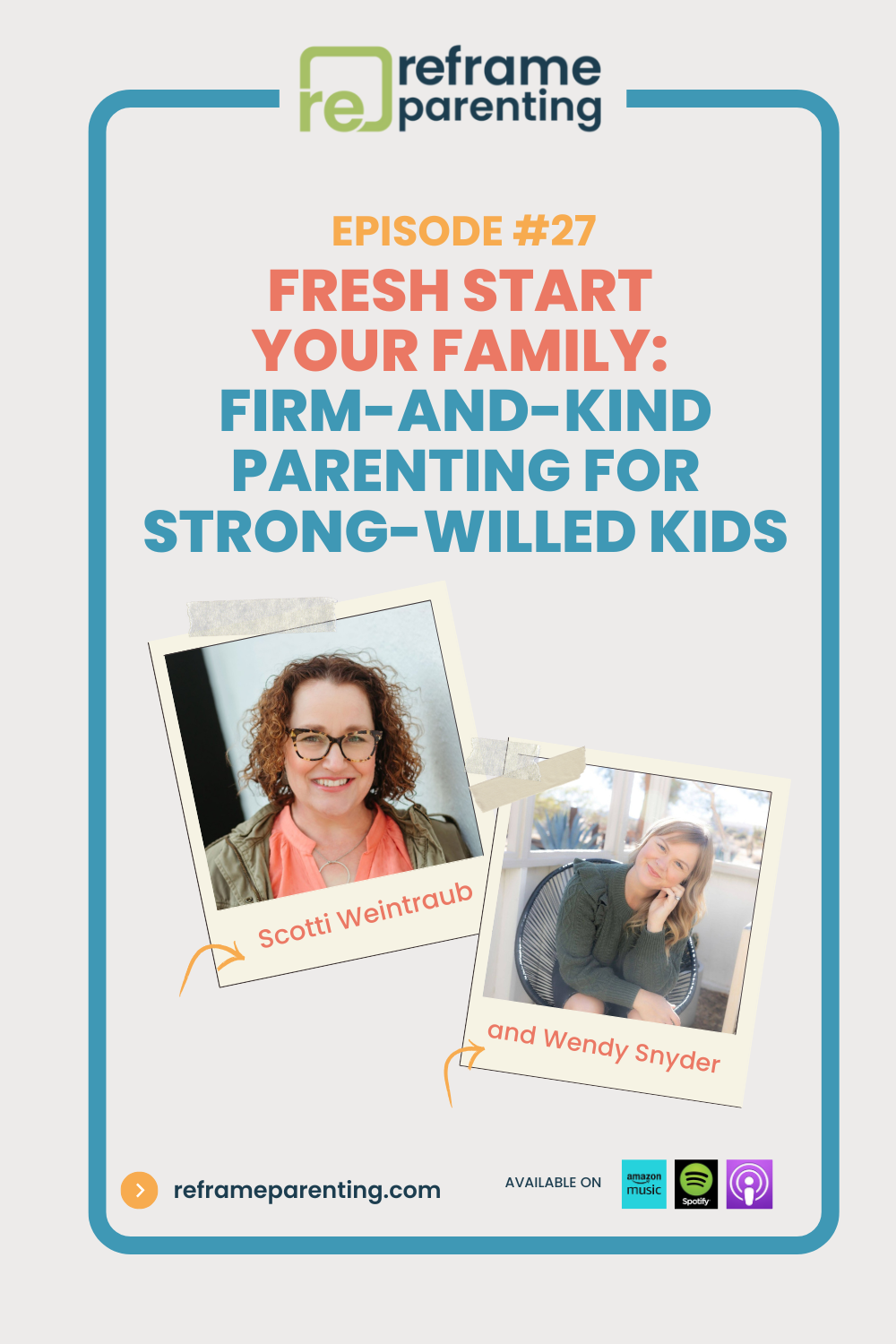
27: Fresh Start Your Family: Firm-and-Kind Parenting for Strong-Willed Kids with Wendy Snyder
If parenting has ever made you think, “Wait… why didn’t anyone warn me it would be THIS hard?”, you’re in good company.
In this episode, I sit down with parenting coach Wendy Snyder to talk about her new book, Fresh Start Your Family (releasing May 26), and what happens when “be stricter” advice totally backfires—especially with strong-willed kids.
Wendy shares her family’s journey from power struggles and punishment-based tools to a relationship-first, firm-and-kind approach that supports real cooperation at home and in school. We also dig into common school discipline issues (like taking away recess), how to advocate without teacher-bashing, and why discipline should build skills—not shame kids into compliance.
Key Takeaways:
Why “power over” parenting (punishment, threats, shame) often creates more rebellion—especially for strong-willed kids.
The difference between being strict (firm boundaries + respect) and being authoritarian (fear + force).
Why punishment is rooted in making kids “pay,” while discipline is about teaching future skills through practice.
How to respond when schools use consequences like taking away recess or shaming kids for being “unprepared.”
How to spot what kinds of teachers your child truly thrives with—and use that information to support them.
What it can look like to advocate for your child (ex: homework pushback) while staying respectful and collaborative.
This episode will help if:
You’ve been told to “just be more strict,” but your child only escalates when you try.
Your kid is labeled “defiant,” “bossy,” “sassy,” or “lazy,” and your gut says there’s a better interpretation.
School consequences feel like they’re making things worse (especially for kids who need movement and connection).
You want to build your advocacy confidence without feeling like you’re attacking teachers or administrators.
You’re trying to break a cycle of reactive or punishment-based parenting and create a calmer, more respectful family culture.
Resources:
Preorder Fresh Start Your Family + bonuses: https://freshstartfamilyonline.com/preorder
Free workshop: Three Secrets to Thriving with Strong-Willed Kids: https://freshstartfamilyonline.com/power
Connect with Wendy Snyder: https://freshstartfamilyonline.com
Connect with Scotti:
Website
Instagram
Threads
LinkedIn
Connect with Wendy:
Ask a Question:
Got a school question on your mind?
Submit it as a listener question for a future episode
Transcript
27: Fresh Start Your Family: Firm-and-Kind Parenting for Strong-Willed Kids Wendy Snyder
Wendy Snyder: [00:00:00] Punishment is usually rooted in the past. It's rooted in retribution, making a child pay their price for the mistake or the infliction that they created.
And then it's often created around the belief that in order to make a child behave better, we must first make them feel worse. And that is just not factual.
it's just so many kids, especially if they're a strong-willed kid, they will revolt against that kind of system, 'cause they will never be forced to respect somebody.
Scotti Weintraub: Welcome to Unlocking School Success, a podcast with the smart strategies and support parents need to help their kids thrive. I'm your host, Scotti Weintraub, parent coach, school navigator, and your go-to guide for turning School Stress and Chaos into clear strategies that work. Let's get started.
Hello, and welcome to another episode of Unlocking School Success. And if you've been listening for a while, you [00:01:00] know I love having guests on my podcast, and today's guest is a special treat. Wendy Snyder is with me. Hi, Wendy.
Wendy Snyder: Thanks for having me, Scotty. I'm so happy to be here.
Scotti Weintraub: I'm excited because you have a new book coming out, and I know you're eager to talk about it, and I know that my listeners will be eager to learn about it.
And because you're a powerful parenting coach and you like talking to parents about a lot of similar issues, I'm really excited for this conversation.
Wendy Snyder: Me too. I am thrilled to be here with you today, specifically talking about this work in relationship to school and all that good stuff. I really respect what you're doing in the world too, Scotty, so I know we're gonna have a really great chat today.
Scotti Weintraub: Yes. The name of your upcoming book, which drops on May 26, which is coming up soon. As we're recording this, we're at the beginning of May. Yeah. And it's called Fresh Start Your Family. And why don't you just give us, a brief overview of what the book's [00:02:00] about and your inspiration for writing it?
Wendy Snyder: Yes. So this book is really- For any parent who's ever gotten into parenthood and been a little surprised by how freaking hard it is, my story is really that when I went to have children, I really thought it was gonna be pretty easy-peasy. I had been, working with children from a young age.
I started coaching springboard diving at 13. I nannied in college. I just thought I was really good with kids. And then, Terry and I had kids, and we got blessed with a very strong-willed little girl, from birth. Her name's Stella. She's now 18. Really, you learn about her entire story in this book, Fresh Start Your Family.
But we got really surprised by how hard it was, and you could feel her strong will from birth, and It wasn't till she was about three, four years old that, the poop really started to hit the fan, and I thought I was gonna lose my mind because no one had ever taught me what to [00:03:00] do when a child, doesn't listen to that level.
And really, I had inherited what we would call a hand-me-down parenting set of tools that no one needed to teach me how to put her in time out or threaten a spanking. Everyone and their uncle around us told us, "Hey, just told, tell her who's boss. Make sure you don't let her, think that she can control the roost."
And we had people, in our faith circles telling us that we needed to break her will. It really felt like everyone we asked, "What do we do with this very feisty, kinda stubborn, little girl that felt we would describe her at the time as defiant, bossy, sassy," all those types of things.
Literally everyone and their uncle, Scotty, just told us to Take that power over angle. And I really did try it for a few months there, and because, 'cause the story goes that, I was working in corporate, we had a nanny full-time, and things were going okay because the nanny was with Stella all the time.
And then as soon as I was home with her [00:04:00] full-time, that's again when things really got dark. And so that, that was a season where we were like, oh my gosh, we were trying all the things, all these books that people had recommended to us that I now realize was the autocratic or authoritarian way, and it never felt right with my heart.
And it wasn't working. She would respond so poorly to these strategies. And finally, we got invited to go to a positive parenting class at her preschool, and within the first day of attending this class, it was like, oh my gosh, the light started to return to my days. I felt like my spirit was coming back.
We started to try these new concepts that were relationship-based, firm and kind strategies that really just harness the, what we would call true power now. 'Cause now as an educator, I call myself someone who teaches powerful parenting, which puts you in a place of true inspiration for your kids instead of a power over system.
And so things just started to change very fast for us, [00:05:00] and within a year, I decided I wanted to teach. And so this book is now a culmination of 15 years of doing this work in our family. So 15 years ago was when Stella was three. She's now 18, and the good news is that she's got on, thank God, because we were taught from an early age how to embrace that strong will, how to handle those many moments of misbehavior and pushback with dignity and grace.
We were taught how to see the good in her. We were taught how to honor her true spirit and her tenacity and her grit and her resistance. She now is just thriving. She's one of I would call my closest friends. Our relationship is the one of my dreams that I wish I would've always had with my own mom.
And the good news is she w- she has gone on to secure a Division I beach volleyball recruitment at a school ranked number in the top 10 in the nation, which has been her dream for a few years. And so this book is about all of that. We really start from the [00:06:00] beginning of when we were in the pits of parenting, and we take you through, what, 15 years of a journey.
So many moments where I got it wrong, so many moments where I did actually succeed at doing a strategy and showing kind of the parents here's what it looks like when I, th- when it failed miserably and why it failed miserably, and here's an example of where it worked so well. And you, and the book journeys through all the years, and as we started to get towards the 8, 10, 13, now we're at the 15-year mark, you can really start to see the success and the stride of what it looks like for a parent to kinda reach full mastery in this work.
So it's a combination of strategy, but it's also a huge storytelling book. I like to teach with vulnerability and humility and just really let parents know that they're not alone. If they are really dissenting from a lineage in their family of reactive parenting, of punishment-pa-based parenting, which is what we would call an autocratic or authoritarian [00:07:00] system, and if their intuition has been screaming at them that there's got to be a better way, we can teach them how.
Scotti Weintraub: Oh I feel like we could have about a dozen conversations based on what you just said, because my story of my own family resonates so much with yours- ... in that I too, was blessed with a strong-willed child who I left my own full-time job because I knew- Yeah ... that he needed more and he needed different.
And those voices, I know anyone listening can recognize that the advice that others give you often doesn't match what your child needs. And so- Yeah ... I am just so pleased that you're putting the, your story out into the world like this, because I know that other families need to hear it. And it does help us feel less alone.
Wendy Snyder: It does. I think it...
Scotti Weintraub: it absolutely does.
Wendy Snyder: Yeah, and I'm excited to kinda just look at the school angle with you, 'cause Scottie, I have [00:08:00] sto- so many stories of what it looked like to stand bravely and courageously in this work throughout the public school system here in California, and we just have so many stories of what it looked like to come beside a child versus to try to use pressure or force, or to just jump on the bandwagon of adhering to some of the systems that I think are designed to mean but just don't work for so many kids, especially strong-willed kids.
So we can- Yeah ... we can really dig in on a lot
Scotti Weintraub: of the school stuff. Yeah let's do that- Yeah ... because it's such an important piece that I think it is so easy for us, as we're getting all of that advice from family, from our community, from our friends from and when we're talking about school, we're also getting that feedback sometimes from teachers and administrators-
Wendy Snyder: Yep
Scotti Weintraub: that what you need to do is just be more strict, tell them what's what.
Wendy Snyder: Always. They always
Scotti Weintraub: tell you that. Punish, punish them until [00:09:00] they, turn their behavior around, or until their grades magically somehow get better. So let's get into that, 'cause I think it's a really rich conversation. So what is the framework that you talk about in the book, as opposed to that sort of authoritarian approach to whether that's school challenges, behavior also in there?
Yeah. What is the alternative?
Wendy Snyder: Yeah. And I will say that there's such a spectrum of authoritarianism or autocratic systems, right? There is the high level, which is the systems and the families that are using a ton of fear and force and shame, and there's lots of yelling.
There's often lots of hitting. And this is both in the school system and in the family system, because let me just remind everybody that it is still legal in 19 states in the United States of America in public school systems to use corporal punishment with children. It's the United- Wild, [00:10:00] but
Scotti Weintraub: true.
Wendy Snyder: Yep
States of America, right? And my sweet mom, she grew up in a very Irish Catholic strict schooling system where they did get hit on the hand with rulers, and they were put in a dunce cap and told to stare at the corner. That's the high level of the auth- autocratic or authoritarian system, right?
They are pedal to the metal with the fear and force, and they will justify it, and they will defend it to their grave. And then at the lower end of that is just what I would just call the normal families. Normal families who just inherited, of course, you put your kid in a timeout if they're three or four or five years old and they don't listen.
Of course they're gonna get punished and get their iPad taken away if they get a red card at preschool or kindergarten or second grade, right? Of course they're gonna get grounded when they're a teenager. Isn't that just what everybody does? That is just normal Standard autocratic parenting, which is the way in the United States of America.
Now, I just had an interview with someone in the Nordic [00:11:00] countries. She's an author who wrote the book, There's No Such Thing as Bad Weather. Her name is Linda McGurk. I love her work. But what's really cool is we talked about how it is not the norm in the Nordic countries. They raise children without this type of system of power over, of punishment, shame, pressure, guilt, all those type of things.
There- many countries it is, but many countries it is not. And I just love that the Nordic countries have the highest levels of happiness. They have the lowest levels of violence. Surprise. It's not rocket science to me. But coming back to just there is always gonna be these spectrums of the system, right?
But in general, any system that is, has elements of punishment, shame, which is like, "What's wrong with you?" Name-calling, "I won't raise an entitled brat," or, "You're being lazy," or, "Don't be mean to your sister, you're being bad." Those are all elements of shame we say. Raising your voice, which would we would call intimidation.
Now, a lot of times, those are knee-jerk patterns for people, so it's not like we're s- waking up in the morning and we're like, "We're gonna [00:12:00] be a fear and force parent." Like- ... it's just what you do. It's like that's your nervous system and how it operates. And
Scotti Weintraub: It's often how we were parented.
Wendy Snyder: Exactly. And that's how the nervous system is conditioned, so we talk a lot about that in the book. But on the other end of that, when parents decide, "Hey, I wanna break the chain," so to speak. "I wanna stop this cycle, and I wanna hand down to my children a different type of leadership system," which we would call a power with system, a democratic- Firm and kind parenting system.
That replicates or that is similar in any system in the world. So leadership systems in government, democratic, firm, and kind is that's great, right? That's what we stand with, and that's what we stand with in the family and school system, same thing. But that is where everyone has a voice. There is mutual respect.
There is safety all around, physical, emotional, and spiritual. And parents lead in a way that kids want to [00:13:00] respect and follow their lead, not because they have to, not because they're scared of their parents, not because they're scared of a teacher, but because they truly respect that, that person, that, that figure of leadership, right?
So we always say that for this type of leadership system to work, the relationship really has to be strong. So rules plus relationship equals respect. Rules minus relationship equals rebellion. We also help any type of leader in this system, parenting, school, whatever it may be, even just family systems greater and greater family systems.
We help them fully p- eliminate a hypocrisy. Hypocrisy is going to always be part of the autocratic or authoritarian system. My way or the highway, do what I say or else, and do what I say, not as I do, right? But the truth is-
...
Wendy Snyder: 99% of what children learn is caught, not taught.
So it's just so many kids, especially if they're a strong-willed kid, they will revolt against that kind of [00:14:00] system, 'cause they will never be forced to respect somebody. And I've had so much fun watching my kids over the years and just noticing what kind of teachers do they respect?
What kind of teachers do they not respect, right? And it often is... my children, especially my daughter, my strong-willed 18-year-old now, she does really actually respect a strict teacher. She does not respect a teacher that us- uses an autocratic system. And we can kinda riff about the differences there between strict, which is what we would call a democratic, firm, and kind system.
There's high boundaries, very firm boundaries. A leader in that type of system is going to help children understand why the boundaries exist and why those boundaries help the s- the kid or the student too. It's not just a because I said so system, right? And again, there's just so much respect given to those leaders, whether it's a parent or a teacher, because there is humility involved.[00:15:00]
I think humility is one of those magic potions that is so undervalued in leadership systems, whether it's parenting or school or whatever, that once you start to see the power of humility and just being willing to admit to kids "Hey, I either made a mistake," or, "I don't know it all," or, "I need your feedback.
I wanna do this as a team. I don't wanna be the know-it-all figure because I'm not the know-it-all. I don't know everything. I do make mistakes. I do need help," kids just really respect that in our world. And then you have a system where they are developing into humans who have intrinsic control muscles.
They're getting good grades because they want to, and it feels good to succeed. It feels good to be a contributing member of society, whether that's in the classroom or in the family system, not because they're scared they're gonna get their iPad taken away.
Scotti Weintraub: Yeah. I- wow you gave us a whole bunch to think about here.
It's so true, I think, [00:16:00] that- Kids thrive on relationships, and especially with regards to school. So you asked that question w- where- Yeah ... how was your child, where did she resonate with certain teachers? And I have asked myself that question too because, and I encourage parents to think about this specifically, 'cause if we can identify what those traits are that the way that they've set up their classroom.
Is it that those firm boundaries are really important to your child? Is it that they add a little humor, and that seems to be something that- ... engages them? What are those pieces? Because I think it's so easy when our kids struggle in school to just feel like school is a, is all bad or always a problem.
And if we can see those highlights and where is our kid having success, that's such valuable information,
Wendy Snyder: right? I agree.
Scotti Weintraub: Yeah. And then you can use that information, not... You can't [00:17:00] necessarily request certain teachers and, schools don't often like you to get involved in that way, but you can use that valuable information to communicate with teachers about, what's worked in the past.
Or, Yeah ... what they really enjoyed about last year's teacher was that they asked their opinion. That's just like-
Wendy Snyder: Yes ...
Scotti Weintraub: those kinds of pieces are s- are, like, so valuable. And I think you also highlighted the system that I think sometimes we assume that a school is somehow a system that is totally- devoid from what is actually happens when you get out of school.
And my son just came home the other day- Yeah ... and said that, a teacher would say when you graduate, you're not in the real world." But I think sometimes kids are forced into these authoritarian systems that don't actually reflect how relationships- Yeah ... how those things are built in, the, quote-unquote, "real world."
And give me some examples. Let's maybe talk through a scenario-
Wendy Snyder: Yeah ...
Scotti Weintraub: where if I'm a parent listening and, I'm [00:18:00] thinking like, "Oh, this is all really good in theory," right? But my kid's in a school where, his teacher takes away recess time, for instance. I hear this one all the time.
Wendy Snyder: Yeah.
Scotti Weintraub: They can't sit still, so they took away recess time, or he didn't finish his work and he has to stay in from a special activity.
Wendy Snyder: Yeah.
Scotti Weintraub: So how am I a parent using that reframe that you're talking about, how might I use this information we're talking about in a scenario like that?
Wendy Snyder: Yeah. I'm gonna, I'm gonna t- I'm gonna talk to that recess punishment here in a minute, but I first just wanna speak to, Scottie, what you said about, so many people in a leadership position really think that they're prepping their kids for the real world, right? I actually just got what I would lovingly refer to as a troll a comment.
When I when I do organic social media, it's usually okay, but when I start to place ads man, do these trolls come out. But w- somebody just told me last week that- Like, what an i- what an idiot I am for thinking [00:19:00] about, d- I was t- it was a video about how to replace threats with what we would call sequencing.
It's just one of the many strategies we teach in the book, and it's so effective. It's so lovely. It's like it works so well, especially with strong-willed kids. But this woman was so sure. She just wanted to eat me up, and she said, "This is such a joke. You are, this is like the the trophy, everyone gets a trophy parenting."
"And you need to set kids up for the real world. And in the real world, they're gonna have autocratic bosses. And this is just creating these weak humans, essentially." And I just had to giggle because it is so inaccurate. So let me give you an example. So before I started my own company, so I've been doing this for over a decade, but I was in corporate America, and this was when I was really good at my job.
This was before I had kids and I got humbled. Yeah. I really thought "I am so good. I can accomplish anything in life." But I did all of our event planning for our sales department and just had so much fun with my job. But I worked for the president at the time. [00:20:00] And so for so many years, I worked for this guy, and he was what I would ex- what I would describe as a democratic firm and kind parent, or f- firm and kind boss.
And he was strict. He was firm. His expectations were so high for us as his team. And I loved working for him. Him and I became so close. We're still friends to this day. Every time I drive by San Clemente, I call him to say hi. He's gone on to be the president of giant organizations. But I worked for him for almost 10 years, and I loved it.
Now, he left, and a new person came in. And this person had autocratic or authoritarian tendencies. It was gnarly. Within three months, people were quitting. He was firing people. I remember my coworkers would come out of off- out of his office just crying, 'cause he would just destroy them. He had no interest in honoring my work from home schedule on Friday.
I was an early work from [00:21:00] homer back in the day when, before this was common And he was just such an autocratic leader, and I was out of there within two months. I took my full maternity leave, I milked it for all it was worth, and then I came back, and I was like, "I'm out of here. Later." So no, not f- those of us who are strong-willed humans or have strong-willed human kids, we will not be forced to work for an authoritarian leader.
So point being, she was just wrong. The best- ... leaders in the world, they actually lead with a democratic, firm, and kind system. Yes, they hold their people accountable, yes, they have high standards, but they do not act in disrespectful, high, almighty ways. Or, and if they do, a lot of those people leave, or the people who stay are just a kind of a different type of human.
So with that said, I believe we are creating humans that are set up for the real world because we [00:22:00] need human beings who are not scared to dissent from authoritarian systems like that. To teach a child th- that no is not a bad word, that if someone is using threats or punishment with you, that it makes sense why that doesn't feel good I lo- I've actually have enjoyed when my kids have had teachers that might dabble in that type of stuff because I get to show them, "Look, this is just a different type of leadership, and how does this feel versus last season or last year when you had Mrs.
Gravely, and when there was a problem in the classroom, she would handle it this way and this w- You see the difference, right? This particular teacher threatens recess, or you see this kid getting in air quotes, "trouble." And they are punished, right? And so we would have these conversations. So all of it is valuable to have these conversations with your kids.
But when you ask about punishment versus discipline, essentially what we are teaching parents is instead of just [00:23:00] throwing down like a, "You get your recess taken away," which is punishment, right? Punishment is usually rooted in the past. It's rooted in retribution, making a child pay their price for the, the mistake or the infliction that they created.
And then it's often created around the belief that in order to make a child behave better, we must first make them feel worse. And that is just not factual. We actually can teach important life skills by using discipline. So discipline is going to be based in the future. We teach, this is the entire section four of the book.
It's about the future. It's about practice. It's about seeing mistakes as opportunities to learn. It's about seeing failure as unfinished success. It's about assuming the dignity and integrity in a human being when they trip and fall. And it is about creating activities or teaching moments that actually fill [00:24:00] the void of the life skill that they're missing.
So if you have a kid that's having trouble keeping their hands to themselves in kindergarten, second grade, and what they really need is to be taught how to dispel that kinesthetic energy, how to take that maybe strong-willed kid personality that might be labeled as bossy. There's a whole book called Lean In that was written by Sheryl Sandberg.
She used to be the president of Facebook- ... a long time ago. And she wrote in that book, "If every six-year-old young woman who, young girl who was told that she was bossy was instead taught how to lead, the world would be a different place." So to come beside children and say, "Hey, you're not a bad kid, and firm boundary, we can't use our hands on anybody in, at school or ever, really.
It's just not the way we wanna solve problems. So here's how we wanna teach you. Here's the activity that we're gonna do for the first 10 minutes of resource, recess [00:25:00] together. We're gonna do a practice a win-win. We're gonna practice a redo or a role play." Again, we teach all this in section four of the book.
"And then once we successfully do that, then I'm gonna high-five you, and I want you to go try it on the playground and see how it goes. And while you're on the playground, I want you to make sure that you run as fast as you can, that you get as much kinesthetic energy out as you can, because you have a huge need to move, to touch, to kick, to run, to climb.
And the more your nervous system has the ability to dispel that energy and get that out there, that's the appropriate place to do that. Pushing your co-classmate is not, right? But you're not a bad kid, you're not crazy, and you will be held responsible, so that's why you're staying in to do this compassionate discipline exercise," which we would call a logical consequence, "for 10 minutes, and then you're free to go."
Does that make sense, the difference between the discipline- ... and punishment?
Scotti Weintraub: Yeah, and I [00:26:00] just personally, I really dislike when recess in particular is used as a punishment or a time to withhold, because as you mentioned for some kids, especially kids who are neurodivergent or sensory-seeking, they need that physical outlet.
So that's- I
Wendy Snyder: think all
Scotti Weintraub: kids ... like, all kids do The
Wendy Snyder: outdoors, oh my gosh,
Scotti Weintraub: the outdoors it's great for all kids.
Wendy Snyder: Yeah.
Scotti Weintraub: But it is especially true for some of the- Yeah ... the kids I know whose parents are listening to this. Yeah. And for them, it's actually doing the opposite of what you want.
Wendy Snyder: Yeah.
And- It's shooting yourself in the foot.
Scotti Weintraub: Yes.
Wendy Snyder: Yes. As a teacher.
Scotti Weintraub: Yes, as a teacher. So I appreciate that example, and what it brought up for me was an example that I battled with when my son was younger, where... And this seems like a very small example, but I think you'll see the bigger picture too, that he, if he came to class without a writing utensil, [00:27:00] he would be shamed, right?
And then he had a teacher who started just handing out tiny golf pencils, very small. It was a public sort of shaming. If you don't have this pencil, how many times do I have to tell you have to be prepared, right? Making them go in front of the whole class and grab a golf pencil and then try to do their, schoolwork with this tiny pencil wasn't actually fixing the challenge of him not being prepared, right?
It was just the shaming part. It was the punishing part. Yeah,
Wendy Snyder: that's interesting.
Scotti Weintraub: And I think what I, when I spoke with the teacher, it was like we're trying to, it was that we're preparing them for the real world piece. And I thought to myself, no, I'm an adult who is a professional. If I go to a meeting and I don't have a pen, what happens?
Wendy Snyder: Someone lovingly lends you one- Yes ... and is "Don't even worry, girl."
Scotti Weintraub: You- Like, "I hear you." You turn to the person next to you and say, "Hey, oh, I forgot a pen," and they get in their bag-
Wendy Snyder: And then- ... and they
Scotti Weintraub: hand you
Wendy Snyder: a pen ... then you feel slightly embarrassed because that's an intrinsic way of knowing hey, next time [00:28:00] I wanna be a little bit more prepared.
That was a little embarrassing. We had to z- push it a minute. We started a minute late 'cause someone was in their purse. But it's an intrinsic feeling of like- and it's- ... yikes, I wanna change that
Scotti Weintraub: behavior ...
Wendy Snyder: but there's no shame.
Scotti Weintraub: And it's a, as you said, like a loving response from someone who cares about you to say, "Okay, I got you."
Wendy Snyder: Yeah. Yeah. And
Scotti Weintraub: why are kids- And I give
Wendy Snyder: somebody- ...
Scotti Weintraub: treated differently? That's my question.
Wendy Snyder: I know. Yeah, and that's what's so fun about that Nordic interview the other day. They, kids there have a bill of rights. They are equally respected humans there. And, in the US and many other countries that are very similar to us, it's just not the same.
And yeah, it's just interesting. We just have a lot of work to do there to treat them with the dignity and respect that we would treat us adults which is questionable too at times, depending what where, situation you're in. But it's true. It's so true. And I will say, Scottie, we're sitting here talking about teachers.
I just wanna say I know you agree with this too. All the mad respect to [00:29:00] teachers, right? Oh. I can't even imagine. 1,000%. 24 kids in a classroom, that was our y- kindergarten count. Or more. Or more. And then high school is up to 30, I think. So please, anyone listening, especial- if you are a teacher, we bow down to you.
We are so grateful for teachers. We cannot even imagine what you guys go through as far as trying to get 24 little small humans to do what you want, and- I am just advocating for this type of education to get into the hands of every amazing teacher on the planet, because they deserve to have more peace and cooperation in their classroom without feeling like they have to make a kid feel bad, without feeling like they have to nag and punish and belittle small humans into submission or compliance.
Because that just feels nasty in our soul. And so I want more teachers, like my dream, I have a certification program, is my dream is for every teacher to have a [00:30:00] parenting certification too, because it's just lovely. Once you learn that all the systems are the same, and I, my prayer is that like these days in college, that they're starting to teach this type of leadership, more and more.
And that's why when my kids were younger, and if there was like a super young teacher, sometimes, you'd worry a little bit. "They're just out of college," right? "Do they really know what they're doing with 30 fourth graders?" But then I would know, like maybe they're starting to teach this type of psychology-rooted education that is different than what they were teaching 30 years ago.
But my hope is that every parent every teacher gets this so they can be blessed in their classroom and they can be blessed in their home too with their own
Scotti Weintraub: kids. I would happily endorse that idea because- Yeah ... it is so important. And I'm with you so much that our teachers are so valuable to us and- Yeah I hope that through my work and your work that we're actually helping [00:31:00] make their job easier.
That- Exactly. We're not here to- Yeah ... to embarrass or shame educators. Yeah. We're here to help them better meet the needs of our own kids, and that- Yeah ... can only benefit them.
Wendy Snyder: And you-- I think it's important that we're having this discussion 'cause it is dicey. As I look at my journey between kindergarten and senior year, Stella graduates the same week the book comes out, which is just wild.
Congratulations. But you do... Thank you. Thank you. You do have to stand in confidence that you are not knocking teachers- Yes ... that you are not knocking your own parents. I write about that in this book. By advocating for this type of system, right? This new way, a new way, you are respecting everybody.
You really are. But if you think that you're disrespecting teachers or you're disrespecting your own parents by doing it differently, you won't use your voice. You won't advocate, right? And in kindergarten, we really-- that was when it [00:32:00] started with us. We really had to start experimenting with what does it look like to stand on a little bit of an island.
We watched the movie the documentary The Race to Nowhere, and it changed our life. It changed our life. Our kids went through public school systems here in California, and if it wasn't for that documentary, I wouldn't have really known to, to advocate for the pullback of homework, right? And now here in California, in SoCal, we don't, kids don't have homework until at least fourth, sixth grade.
Now, some of the private schools still get it 'cause they're just like really believe that it's, that is, air quotes, preparing them for later. But what The Race to Nowhere really did so much research and proof of is it doesn't make the test scores better. So you just see, you see it roll out.
But in kindergarten, we had to find the courage to go-- to say to the teacher, "Hey, heads up that we're gonna prioritize Stella literally being in trees- Sitting down and having a family meal, going to bed on time at [00:33:00] night, and like running and playing after school versus being forced to do the sight words that she hates and the homework packets that are bringing tears and fights to our family.
So just so you know, you might get a homework packet back that's not done, and we're okay with that. So do you understand, right? And I'll never forget the day that Mrs. Luna called a meeting, and we thought we were just going into Mrs. Luna's classroom to discuss, right? The principal was there.
And we had to be like, "Hi, yes, this is what we believe in, and this is what we advocate for." And I was new to being a parenting coach at the time, so I was not confident yet. But we stayed the course. We found the confidence, and by the second grade, Stella was thriving in her test scores. The reason why that meeting had been called was because she was scoring a 63% on the reading scale, and they were very concerned.
And they were basically saying, "She needs to get a tutor and do more work at night." And we were saying, "Actually, I think she needs more nature [00:34:00] and just more joy of learning. Yes, we're gonna read every night, but we just don't think the homework is the way." And so by the second grade, really the end of the first grade she was doing great.
She was thriving, and then she's... she's graduated with a four point... She'll be graduating with a 4.4 GPA. She's been like a straight-A student her whole life. But it... The point being is it took standing in confidence and doing it with respect and dignity to work with the teachers and still advocate even when they were like no, you're drinking a little Kool-Aid," and you...
to lovingly go back and forth and be like, "Okay here's the research we found," or, "Here's a documentary. Thank you for all you do, and we are not gonna turn in the homework packets."
Scotti Weintraub: Un- unfortunately, we're gonna have to wrap up, 'cause I know we could keep going.
Wendy Snyder: Yeah.
Scotti Weintraub: But I think you touched on some points that I always talk about, too, around, gaining confidence in your own advocacy skills as a parent.
Yeah. And so folks listening will find other podcast episodes where we definitely [00:35:00] touch on that. Because I think it is your greatest tool as you move through school and through all of your parenting challenges is to be able to do that loving and kind advocacy in partnership and building those relationships, yeah. I thank you for being here and helping so many parents through your work and through this new book. So why don't you just mention where can folks find Fresh Start Your Family when it launches in a few weeks?
Wendy Snyder: Yes. Fresh Start Your Family, wherever books are sold. Amazon, Barnes & Noble. We are trying to get into Target.
It is my dream to get into Target. And then if you do have a strong-willed kid, come jump in my classroom with me. I teach a free workshop called Three Secrets to Thriving with Strong-Willed Kids, and you can come find that at freshstartfamilyonline.com/power.
I'll help you learn how to work with these power struggles with dignity and connection.
Scotti Weintraub: Oh, I hope [00:36:00] that everyone takes advantage of that, and I will for sure have all the links in the show notes so you don't have to worry about writing those down. It is such a pleasure, and I can't wait to get my hands on it.
Wendy Snyder: Thank you, Scotty ...
Scotti Weintraub: thank you so much, Wendy, for all of your work and for helping families in the way that you do. And it's been really fun.
Wendy Snyder: Thank you, Scotty.
Scotti Weintraub: And with that, we're wrapping up another episode of Unlocking School Success.
If you enjoyed this conversation, I hope that you will follow or give us a rating, 'cause it really does help get these kinds of critical conversations in front of other parents. Thanks. We'll see you next time.
thanks for tuning in to Unlocking School Success. If you're finding these episodes helpful, please hit follow, leave a review, or send it to another parent who's also navigating the school maze because no one should have to figure this out alone. You'll find full show [00:37:00] notes@reframeparenting.com slash podcast and you can come say hi on Instagram at Reframe Parenting.
Thanks again for listening. See you next time.